KCM vs. CMAP: What Part 135 and Part 91 Pilots Should Know About Airports with KCM Transitioning to CMAP
On June 22, 2026, the TSA activated its first Crewmember Access Point (CMAP) screening stations at Ronald Reagan Washington National (DCA) and Washington Dulles International (IAD) — marking the beginning of the end for the Known Crewmember (KCM) program that pilots have used for over a decade. Harry Reid International (LAS) followed one week later. Between now and September 30, 2026, every airport with KCM will transition to CMAP, a biometric-based system managed entirely by the TSA.
Most coverage of the KCM to CMAP transition has focused squarely on major airline crews. But Part 135 and Part 91 pilots — charter, air taxi, and corporate aviation professionals — face their own set of questions about eligibility, operator participation, and what actually changes at airports with KCM access points. This article addresses that gap directly. It explains the operational differences between KCM and CMAP, identifies which airports with KCM have transitioned, clarifies whether your operator qualifies, and outlines the training and administrative steps that must happen before the transition completes.
TSA Launches CMAP: The End of KCM at U.S. Airports
The Crewmember Access Point program is not a cosmetic rebrand of the Known Crewmember program. It represents a structural shift in how crew access is managed at U.S. airports. The most significant change is administrative: the TSA is now the sole administrator of the program, ending the joint partnership between the Air Line Pilots Association (ALPA) and Airlines for America (A4A) that managed KCM for years.
The KCM to CMAP transition window runs from June 22 to September 30, 2026, with the TSA scheduled to fully assume all KCM functions by the end of 2026. DCA and IAD went live with CMAP on June 22, 2026. LAS followed on June 29, 2026. Additional airports with KCM will transition on a rolling basis through the fall.
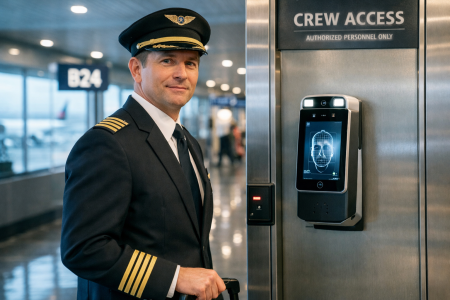
During this transition period, CMAP access points are co-located with existing KCM points — meaning pilots will go to the same physical locations they have always used. But they will encounter a new process. The barcode scanner is being replaced by a facial recognition scan. The back-end security architecture is fundamentally different. And the TSA, not an industry consortium, now controls enrollment, verification, and screening protocols.
For Part 135 and Part 91 pilots who have relied on KCM at airports transitioning to CMAP, the implications go beyond swapping one scan for another. Eligibility, operator participation, credentialing, and fee structures all demand attention.
What Is the Difference Between KCM and CMAP?
The practical difference at the access point may feel modest — a facial scan instead of a barcode scan. But the operational and administrative differences between the Known Crewmember program and the Crewmember Access Point program are substantial. Here is what changes.
KCM: How It Worked
Under KCM, a pilot approached the crew access point and presented an airline credential. A barcode on the credential was scanned, and the system verified the pilot’s identity against airline records. The pilot was then either cleared to bypass the standard TSA checkpoint or flagged for random secondary screening. The program was jointly managed by ALPA and A4A, with participating airlines maintaining their own crew lists and credentialing processes.
CMAP: What Changes at the Access Point
Under CMAP, a pilot approaches the dedicated access point and undergoes a facial recognition scan. The biometric data is matched against TSA records — no physical badge or barcode is required for the scan itself. The pilot is then either cleared or flagged for random screening, just as before. But the TSA manages the entire process from enrollment to verification.
Pilots who have used CMAP at DCA, IAD, or LAS have described the practical difference at the point of entry as minimal: “You’re doing a facial scan instead of a barcode scan. No badges.” But the back-end architecture is fundamentally different. CMAP mandates standardized screening protocols regardless of duty status or uniform appearance. The TSA retains full authority for random screening within CMAP lanes. And biometric verification does not eliminate all identification requirements — crew may still need to link credentials to government-issued passports for identity verification.
That last point deserves emphasis. Facial recognition replaces the barcode, but it does not replace all credential requirements. Pilots should not assume that a facial scan alone is sufficient. Passport-linked credentialing is part of the CMAP framework, and crew members should confirm their credentials are properly linked before arriving at a CMAP airport access point.
Which Airports Have CMAP — and Where Are KCM Airports Still Active?
As of late June 2026, only three airports with KCM have completed the switch to active CMAP screening:
- Ronald Reagan Washington National (DCA) — live as of June 22, 2026
- Washington Dulles International (IAD) — live as of June 22, 2026
- Harry Reid International (LAS) — live as of June 29, 2026
Additional airports will transition between now and September 30, 2026. The TSA has not published a comprehensive public schedule for every airport, so pilots should check with their operator or the TSA directly for the most current airport-by-airport status. The TSA’s official crewmember access resources are the authoritative source for real-time transition updates.
At airports where CMAP is active, access points occupy the same physical locations as the former KCM points. At airports that have not yet transitioned, KCM remains operational. During the overlap period, some airports may run both systems simultaneously. By the end of 2026, the TSA plans to have fully assumed all KCM functions nationwide.
For pilots who operate into multiple airports, the advice is straightforward: know which system is active at your destination before you arrive.
Can Part 135 and Part 91 Pilots Use CMAP?
This is the question that most existing coverage fails to answer clearly. The short answer: yes, conditionally.
CMAP is available to eligible crewmembers of “participating aircraft operators.” That language is not limited to Part 121 carriers. If a Part 135 or Part 91 operator chooses to participate in the program, submits a Master Crew List to the TSA, and pays the $19 per employee annual fee, their crew members may qualify for CMAP biometric screening at participating airports. The extent of Part 91 eligibility depends on the operator type and TSA acceptance of their enrollment — treat this as conditional eligibility, not a guarantee, and confirm directly with your operator and the TSA.
The key word is “participates.” CMAP enrollment is voluntary at both the operator level and the individual crew member level. An operator must actively opt in, submit the required Master Crew List, and maintain compliance with the TSA’s billing and enrollment requirements. Individual crew members who prefer not to use CMAP — or whose operator has not enrolled — must use standard TSA checkpoints. Opting out carries no penalty beyond using the standard screening lane.
This creates a practical gap for many charter, air taxi, and corporate aviation pilots. Most existing coverage assumes a major airline audience, where enrollment is handled at scale by a corporate flight operations department. For smaller Part 135 operators or Part 91 flight departments, the decision to participate may not have been made yet — or may not have been communicated to line pilots.
If you are a Part 135 or Part 91 pilot and you want CMAP access at airports with KCM transitioning to the new system, contact your Director of Operations to determine whether your operator is participating or plans to participate. Confirm that your name is on the Master Crew List and that your credentials are linked to your government-issued passport. Do not assume enrollment has happened on your behalf.
The $19 Fee and the 30-Day Compliance Window
The financial structure of CMAP differs significantly from KCM. Under the new program, the TSA will bill participating aircraft operators $19 per employee annually, effective January 1, 2027. Note that “employee” includes flight attendants and other crewmembers, not pilots alone. This fee is billed to the operator, not the individual crew member.
For major airlines, the numbers are substantial. American Airlines, with approximately 47,500 employees, is projected to pay roughly $2.64 million annually under CMAP — an estimate derived from the $19 fee multiplied by the publicly reported employee count. For a Part 135 operator with 15 or 20 crew members, the total annual cost is modest: a few hundred dollars at most.
The real risk is not the dollar amount. It is the 30-day compliance window. Operators have 30 days from invoice receipt to pay. If payment is not made within that window, crew members on the operator’s Master Crew List face de-enrollment from the program — meaning those crew members must use standard TSA screening lanes until the matter is resolved.
This is an operator-level administrative responsibility, but a missed payment directly affects every pilot and crew member on the list. Flight operations managers, Chief Pilots, and accounting departments must treat the CMAP invoice as a time-critical compliance obligation. For smaller operators without dedicated compliance staff, the 30-day window demands a clear internal process to avoid an operational disruption that no pilot wants to discover at the access point.
What This Means for Training and E-Learning Programs
The KCM to CMAP transition creates immediate training obligations for Part 135 and Part 91 operators. Training modules must be updated to address several key areas:
- Biometric verification process: Crew must understand how facial recognition works at CMAP access points, including the elimination of badge and barcode requirements and the continued need for passport-linked credentials.
- Uniform screening protocols: CMAP access is not guaranteed. Crew may be flagged for random screening regardless of duty status, uniform, or prior clearance history. Training must set this expectation clearly.
- Passport-linked credentialing: Pilots must know how to verify that their credentials are properly linked to government-issued passports before arriving at a CMAP airport. Training should include step-by-step guidance on this process.
- Voluntary participation: Crew must understand that CMAP is voluntary and that opting out means using standard TSA checkpoints — not that access will be denied or penalized.
- Administrative compliance: Training for flight operations managers must incorporate the $19 fee structure, the 30-day payment window from invoice receipt, and the de-enrollment consequences of a missed payment.
No widely available structured training content currently addresses these changes in a format designed for Part 135 or Part 91 audiences. This gap will only widen as more airports with KCM transition through September 2026. Training departments and Chief Pilots need to build CMAP awareness into recurrent training and compliance workflows now — not after the transition completes.
Structured e-learning programs designed for Part 135 and Part 91 operators can help training departments close these gaps efficiently. Explore CTS’s Part 135 Training and IS-BAO/Part 91 Training packages to keep your crew current on aviation security compliance in 2026 and beyond.
Frequently Asked Questions About Airports with KCM and CMAP
What is the difference between KCM and CMAP?
CMAP replaces KCM’s barcode scanning with biometric facial recognition and is managed entirely by the TSA rather than the joint ALPA/A4A industry partnership. The Crewmember Access Point process occurs at the same physical locations as former KCM access points at airports with KCM. CMAP also mandates standardized screening protocols regardless of duty status or uniform.
Which airports have switched to CMAP from KCM?
As of late June 2026, DCA and IAD went live with CMAP on June 22, 2026, and LAS followed on June 29, 2026. All remaining airports with KCM will transition through September 30, 2026, with full TSA implementation expected by the end of 2026. Pilots should verify current status with their operator or the TSA.
Can Part 91 or Part 135 pilots use CMAP at airports?
Conditionally, yes. If their aircraft operator participates by submitting a Master Crew List to the TSA and paying the $19 per employee annual fee, their crew members may qualify. Eligibility is not guaranteed — it depends on operator type and TSA acceptance. Participation is voluntary for both operators and individual crew members. Part 135 and Part 91 pilots should confirm enrollment status with their Director of Operations and the TSA directly.
How does biometric facial recognition work at CMAP access points?
Crew approach the CMAP access point and undergo a facial recognition scan that matches their biometric data against TSA records. No physical badge or barcode is required for the scan. Crew may still be subject to random additional screening, and credentials must be linked to government-issued passports for identity verification.
Is the Known Crewmember program being discontinued?
Yes. KCM is being fully replaced by CMAP. The KCM to CMAP transition began June 22, 2026, with DCA and IAD as the first airports with KCM to go live. The TSA is scheduled to assume all KCM functions by the end of 2026. KCM remains operational at airports that have not yet transitioned to CMAP.
Stay current on regulatory changes affecting crew access and airport security by bookmarking this page and exploring CTS’s Part 135 and Part 91 compliance training resources.