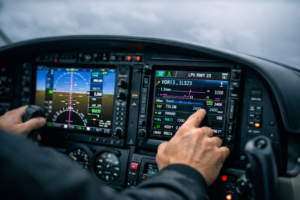

VMC in Aviation: Weather Minimums, IMC Transitions & Vmc Speed
VMC vs IMC: A Real-World Guide for Charter and Corporate Pilots What VMC Means in Aviation — And Why the Definition Matters More Than You Think A Part 135 charter crew departs VFR on a

VMC vs IMC: A Real-World Guide for Charter and Corporate Pilots What VMC Means in Aviation — And Why the Definition Matters More Than You Think A Part 135 charter crew departs VFR on a

Aviation Hazmat Training: Will-Not-Carry and Will-Carry Programs Explained Aviation hazmat training is a regulatory obligation that catches many operators off guard. If your operation has a Will-Not-Carry policy, does that mean your pilots and ground

Night Vision Goggle Online Training for Pilots: Night Operations, Human Factors, and Safety Risks Generation 3 night vision goggles can amplify starlight into a usable image through advanced photocathode and micro-channel plate technology — yet

Accelerated Slipstream, The Force that Shapes Takeoff, Climb, and Control When pilots think about propellers, they usually think in terms of thrust — air being pushed backward to move the airplane forward. But a propeller

Accelerated Slipstream When One Engine Changes Everything In multi-engine airplanes, accelerated slipstream is no longer just a helpful byproduct of the propellers — it becomes a dominant asymmetric force whenever the engines are not producing

Density Altitude and Useful Load, When Performance Margins Disappear On paper, useful load tells you what you’re allowed to carry. In the real world, density altitude decides whether the airplane can actually perform while carrying it. Density altitude is pressure altitude corrected for temperature (and

Why Load Factors Matter to Critical Angle of Attack Load factor describes the ratio of lift an aircraft must produce compared to its weight. In straight-and-level, unaccelerated flight, that load factor is 1G. However, the moment an aircraft enters a

Discover the Critical Angle of Attack The critical angle of attack is the maximum angle between the wing’s chord line and the relative wind at which lift can be maintained. When this angle is exceeded, airflow separates from

De-Icing vs. Anti-Icing: What Every Pilot Must Know About Winter Aviation Weather Winter flying brings beautiful skies, and some of the most unforgiving hazards aviation has to offer. Among the most misunderstood winter safety topics is the difference between

Risk Identification and Mitigation A preflight briefing is only as good as the decisions it generates. AC 91-92 emphasizes that pilots must turn information into action through structured risk assessment. The goal is to understand

VMC vs IMC: A Real-World Guide for Charter and Corporate Pilots What VMC Means in Aviation — And Why the Definition Matters More Than You Think A Part 135 charter crew departs VFR on a

Aviation Hazmat Training: Will-Not-Carry and Will-Carry Programs Explained Aviation hazmat training is a regulatory obligation that catches many operators off guard. If your operation has a Will-Not-Carry policy, does that mean your pilots and ground

Night Vision Goggle Online Training for Pilots: Night Operations, Human Factors, and Safety Risks Generation 3 night vision goggles can amplify starlight into a usable image through advanced photocathode and micro-channel plate technology — yet

Accelerated Slipstream, The Force that Shapes Takeoff, Climb, and Control When pilots think about propellers, they usually think in terms of thrust — air being pushed backward to move the airplane forward. But a propeller

Accelerated Slipstream When One Engine Changes Everything In multi-engine airplanes, accelerated slipstream is no longer just a helpful byproduct of the propellers — it becomes a dominant asymmetric force whenever the engines are not producing

Density Altitude and Useful Load, When Performance Margins Disappear On paper, useful load tells you what you’re allowed to carry. In the real world, density altitude decides whether the airplane can actually perform while carrying it. Density altitude is pressure altitude corrected for temperature (and

Why Load Factors Matter to Critical Angle of Attack Load factor describes the ratio of lift an aircraft must produce compared to its weight. In straight-and-level, unaccelerated flight, that load factor is 1G. However, the moment an aircraft enters a

Discover the Critical Angle of Attack The critical angle of attack is the maximum angle between the wing’s chord line and the relative wind at which lift can be maintained. When this angle is exceeded, airflow separates from

De-Icing vs. Anti-Icing: What Every Pilot Must Know About Winter Aviation Weather Winter flying brings beautiful skies, and some of the most unforgiving hazards aviation has to offer. Among the most misunderstood winter safety topics is the difference between

Risk Identification and Mitigation A preflight briefing is only as good as the decisions it generates. AC 91-92 emphasizes that pilots must turn information into action through structured risk assessment. The goal is to understand