What Is CPDLC? A Plain-English Guide to Controller Pilot Data Link Communications
Imagine you’re at FL370 over the North Atlantic, 800 miles from the nearest VHF relay station. You need a higher altitude to optimize fuel burn, but the voice frequency is congested — three other crews are trying to get through to Shanwick Oceanic on the same HF channel. Now imagine sending that request as a text message and receiving your clearance back in seconds, digitally, with zero chance of a read-back error. That’s CPDLC — and it’s no longer an oceanic-only technology. Understanding
controller pilot data link communications has become essential for any operator flying modern airspace.
What Is Controller Pilot Data Link Communications (CPDLC)? The Basics
Controller pilot data link communications (CPDLC) is a digital, text-based messaging system that enables controllers and pilots to exchange standardized ATC clearances, instructions, and requests via data link instead of voice radio. Defined in ICAO Doc 4444 (PANS-ATM) as a two-way data link system for transmitting non-urgent strategic ATC messages, CPDLC provides a structured communication channel that reduces reliance on congested voice frequencies.
One critical point to establish from the start: CPDLC
supplements voice communication. It does not replace it. Voice radio remains the primary method for urgent, complex, and non-standard communications, and it serves as the mandatory fallback when data link systems fail.
You may hear CPDLC described as “aviation’s version of text messaging,” and the analogy is useful — but it requires immediate qualification. Unlike casual texting, CPDLC uses pre-formatted, standardized messages that demand specific procedural knowledge. There is no free-text conversation happening here. Every message follows a defined structure, and every response carries operational and regulatory weight.
CPDLC’s primary deployment has historically been in oceanic and remote airspace where VHF voice coverage is limited. Increasingly, however, it is expanding into high-density enroute airspace in the United States and globally. This guide walks through how controller pilot data link communications work, what the regulations say, what equipment your aircraft needs, and what training competencies your crew must develop to operate CPDLC safely and in compliance.
How CPDLC Works: A Step-by-Step Message Exchange
Understanding how controller pilot data link communications function in practice starts in the cockpit. Here is a typical CPDLC message exchange from start to finish.
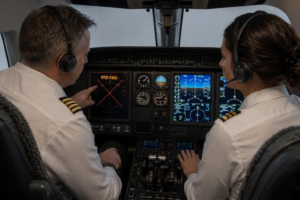
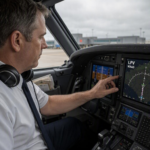
A controller initiates a message from their ground system — say, a climb clearance. That message travels via data link and appears on the pilot’s CDU, MCDU, or EFB display as a standardized text instruction. The pilot reads and interprets the message, verifies its content against the current flight situation, and then responds using one of four standardized options:
- WILCO — “I will comply with this instruction.”
- UNABLE — “I cannot comply” (typically followed by a reason or alternative request).
- STANDBY — “I need more time to evaluate before responding.”
- ROGER — “I have received and understand the message” (used for information-only messages that do not require compliance).
The controller’s system logs the pilot’s response, creating a digital record of the exchange. No ambiguity about whether the clearance was received. No question about what was read back.
Here is a concrete example: ATC sends
“CLIMB TO FL380.” The pilot sees this message appear on the MCDU, reviews it against current conditions and aircraft performance, and responds
WILCO with a single button press. The controller’s display confirms the pilot’s acceptance. Compare this with voice radio, where accent misunderstandings, frequency congestion, and read-back/hear-back errors can introduce risk into every exchange. The system also supports error detection and reporting capabilities, flagging inconsistencies that might otherwise go unnoticed in a voice environment.
Common CPDLC Message Types
CPDLC messages fall into several standardized categories. These are pre-formatted — not free-text — and each carries specific procedural expectations:
- Altitude clearances — Climb or descend instructions (e.g., “CLIMB TO FL400”).
- Route modifications — Lateral routing changes and direct-to instructions (e.g., “PROCEED DIRECT TO WAYPOINT”).
- Speed instructions — Mach or indicated airspeed assignments.
- Frequency changes — Transfer of communications to a new ATC facility or frequency.
- Pilot requests — Requests initiated by the crew for higher altitude, direct routing, or weather deviation clearance.
CPDLC vs. Voice Radio vs. ACARS: What’s the Difference?
One of the most persistent misconceptions in data link communications aviation is the confusion between CPDLC, voice radio, and ACARS. These are three distinct communication systems serving different functions.
- Voice radio — The traditional method. Real-time, immediate, and remains primary for urgent and non-standard communications. Subject to frequency congestion, language barriers, and read-back/hear-back errors.
- CPDLC — Digital, standardized ATC messaging for routine clearances and instructions between controller and pilot. Supplements voice. Does not replace it.
- ACARS — An operational and maintenance data link system used by airlines for weather updates, fuel data, gate information, crew scheduling, and similar functions. ACARS is not used for direct ATC messaging.
The key distinction: CPDLC is strictly for structured controller-pilot ATC communication, while ACARS serves broader airline operational functions. They are related technologies that share some infrastructure, but they are not interchangeable. Voice remains the fallback for any situation involving urgency, complexity, or system failure.
Where CPDLC Is Used — and Where It’s Expanding
CPDLC’s traditional stronghold is oceanic and remote airspace — the North Atlantic Tracks, Pacific routes, and other areas where VHF voice coverage is limited or nonexistent. In these environments, CPDLC oceanic airspace procedures have become integral to daily operations, enabling clearances that would otherwise require unreliable HF radio transmissions.
But the operational picture is changing. The
FAA DataComm program is actively expanding CPDLC into US domestic enroute airspace. This means controllers can now send digital clearances for routine tasks — altitude changes, route modifications, speed assignments — in high-density domestic sectors where voice frequency congestion has long been a constraint. CPDLC increases sector capacity by allowing simultaneous handling of pilot requests without cluttering voice frequencies.
Globally, CPDLC adoption is accelerating as part of air traffic management modernization. The implication for operators is direct: if you have previously dismissed CPDLC as “only for oceanic,” it is time to reassess. The technology is moving into the airspace where most commercial and business aviation operations spend the majority of their flight time. Operators flying busy US enroute sectors should be evaluating their equipage and crew readiness now, not after the transition is complete.
Regulatory Framework: Is CPDLC Required for Your Operation?
This is where many operators get stuck — unsure whether controller pilot data link communications are required for their specific operation. The regulatory picture becomes clear once you break it down by operator type.
Under
14 CFR Part 91, § 91.123, CPDLC is an acceptable method for delivering and accepting an ATC clearance in the United States. However — and this is critical — there is currently
no requirement in Title 14 of the CFR to have data link communications when operating solely within the US National Airspace System. No domestic mandate exists. The requirements apply based on your operation type and the airspace you intend to use.
Part 121, 125, and 135 Operators
Operators under Part 121, 125, and 135 who require data link for reduced separation standards in oceanic or overseas areas must obtain FAA design approval and revise their
OpSpecs accordingly. This is the compliance pathway for air carriers and charter operators flying oceanic or international routes where CPDLC is mandated by the controlling authority or required for operational benefits like reduced separation.
Part 91 and 91K Operators
Part 91 operators do not need operational authorization for data link communications within the US. However, they may apply for a
Letter of Authorization (LOA) for operations in foreign oceanic or remote airspace that requires specific data link approval. Part 91K operators must revise their
MSpecs. For corporate and business aviation operators uncertain about their obligations, the determining factor is whether your routes take you into airspace where CPDLC is required by the governing authority.
Equipment Requirements
For US enroute CPDLC operations, modern equipage requirements are specific:
FANS 1/A(+),
VDL Mode 2 Multi-Frequency, and
push-to-load FMS capability. The aircraft must have a Communication Management Unit (CMU) — or ATSU on Airbus platforms — and a VHF Data Radio (VDR). Equipage requirements vary based on whether your operation needs Departure Clearance (DCL) capability only or full enroute CPDLC capability. Additionally,
AC 20-160A provides airworthiness approval guidance for aircraft with installed Data Link Recording systems that record CPDLC messages in crash-survivable memory. These are concrete benchmarks you can check against your current fleet configuration.
Training Implications: What Your Crew Needs to Know
Despite its resemblance to “texting,” CPDLC requires specific procedural training. The standardized message formats, FMS integration steps, and automation interface introduce error risks that do not exist in voice operations. Training managers and check airmen need a clear framework for building CPDLC competency into their curricula. For operators building or updating CPDLC ground training programs, structured e-learning modules can provide the standardized procedural foundation crews need —
explore CTS training options for Part 135 and
Part 91/IS-BAO operations.
Here are the core training pillars every CPDLC training module should address.
Message Interpretation and Response Procedures
Pilots must be trained to read, interpret, and digitally acknowledge standardized CPDLC messages correctly. This means understanding each message type, knowing the appropriate response (WILCO, UNABLE, STANDBY, ROGER), and — critically — verifying the content of the instruction before executing it. The procedural shift from voice-based clearance reception to text-based message management requires deliberate practice, not assumption.
Push-to-Load and FMS Integration
When a routing change arrives via CPDLC, many modern avionics systems offer a push-to-load procedure that incorporates the new route directly into the Flight Management System. This is a critical training element and a key source of automation error if performed incorrectly. Crews must verify that the loaded route matches the clearance before executing the change. An incorrect push-to-load can silently insert an error into the FMS that goes undetected until it creates a track deviation or separation issue.
System Failure and Voice Reversion
What happens when CPDLC fails? Crews must remain proficient in voice communication for urgent, non-standard, or system-failure scenarios. Training must include voice reversion procedures so that a data link failure does not create operational disruption or leave pilots uncertain about how to re-establish communication with ATC. CPDLC is one pillar of oceanic situational awareness alongside ADS-B and position reporting — but voice proficiency remains the foundation beneath all of them.
Frequently Asked Questions About CPDLC
What Is CPDLC and How Does It Work?
CPDLC — controller pilot data link communications — is a digital, text-based messaging system defined by ICAO Doc 4444 that enables controllers and pilots to exchange standardized ATC clearances and requests via data link. Controllers send pre-formatted instructions to the cockpit display; pilots review and respond with standardized acknowledgments. The system creates a digital record of every exchange.
Does CPDLC Replace Voice Radio Communication?
No. CPDLC supplements voice communication — it does not replace it. Voice radio remains the primary method for urgent, complex, and non-standard communications and serves as the mandatory fallback during any data link system failure.
Is CPDLC Required for All Flights in the US?
No. There is currently no domestic CPDLC mandate in Title 14 of the CFR for operations solely within the US National Airspace System. Requirements apply to oceanic and remote operations under specific OpSpecs (Part 121, 125, 135), MSpecs (Part 91K), or LOAs (Part 91 in foreign airspace).
What Is the Difference Between CPDLC and ACARS?
CPDLC is used for structured ATC communication between controller and pilot — clearances, instructions, and requests. ACARS is primarily an airline operational and maintenance messaging system handling weather data, fuel information, gate assignments, and crew scheduling. They serve different functions and are not interchangeable.
What Avionics Equipment Is Needed for CPDLC?
US enroute CPDLC operations require FANS 1/A(+), VDL Mode 2 Multi-Frequency, and push-to-load FMS capability. Aircraft also need a Communication Management Unit (CMU) or ATSU and a VHF Data Radio (VDR). Equipage requirements differ depending on whether the operator needs DCL-only or full enroute capability.
Preparing Your Operation for Controller Pilot Data Link Communications
Controller pilot data link communications are expanding beyond their oceanic origins into the domestic enroute environment. The FAA DataComm program is making that transition real, and operators who wait to respond will find themselves catching up rather than staying ahead.
Three action areas should be on your agenda. First, determine your regulatory obligations based on your operation type, certificate, and the routes you fly — the requirements differ meaningfully between Part 121 and Part 91 operators. Second, verify your fleet’s avionics equipage against current FANS 1/A(+), VDL Mode 2, and push-to-load requirements. Third, ensure your training program covers the competencies that matter: message interpretation and response procedures, push-to-load FMS integration, and voice reversion for system failures.
Despite its intuitive appearance, CPDLC demands specific procedural training. Structured e-learning programs can accelerate crew readiness by providing standardized, repeatable instruction on exactly these competencies.
CTS’s Part 135 and
Part 91/IS-BAO training programs are built to help operators prepare their crews for CPDLC operations and evolving data link requirements — ensuring your team is compliant and confident as the operational environment continues to transition.