Flight Attendant Recurrent Training: A Compliance Guide for Part 135 and Corporate Aviation Crews
Why Flight Attendant Recurrent Training Matters in Business Aviation
If one of your flight attendants completed flight attendant recurrent training on March 15 of last year, do you know the exact date their currency expires? Most operators assume they have until March 15 of this year — but under 14 CFR §135.343, the window is tied to the beginning of the calendar month in which training was completed. That means currency expires at the end of February, not mid-March. That single misunderstanding is one of the most common compliance gaps found during FAA Part 135 surveillance.
Flight attendant recurrent training is a binding FAA requirement for Part 135 certificate holders, and it is increasingly relevant for corporate and Part 91K operations as well. This is not an optional professional development exercise. A flight attendant who has not completed recurrent training within the preceding 12 calendar months cannot legally serve as a required crewmember — regardless of experience level. This guide walks operators and training managers through the regulatory requirements, required content areas, delivery models, and compliance best practices specific to Part 135 and corporate flight attendant training programs — not airline Part 121 operations.
There is a persistent misconception that corporate flight attendants operate in a less regulated environment than their airline counterparts. In reality, Part 135 cabin crews face the same categories of in-flight emergencies — fire, decompression, evacuation, medical events — but often with smaller teams, highly customized cabins, and less institutional training infrastructure. Training documentation and currency tracking are among the highest-risk areas flagged during FAA Part 135 surveillance. Treating cabin crew recurrent training as a once-a-year formality invites both regulatory exposure and operational risk.
FAA Regulatory Framework for Part 135 Flight Attendant Recurrent Training
Three sections of 14 CFR Part 135 form the regulatory backbone of cabin safety recurrent training. Each imposes distinct obligations. Understanding what they require — and how they interact — is essential for any Director of Operations or training manager responsible for crewmember currency.
14 CFR §135.329 — Crewmember Training Requirements
This is the core rule. 14 CFR §135.329 requires each certificate holder to ensure that every crewmember, including flight attendants, receives recurrent training and remains currently proficient for the aircraft type and position assigned. The regulation mandates a knowledge review plus instruction as needed in subjects required for initial training — including CRM, low-altitude windshear awareness, ground icing conditions, and emergency procedures as applicable.
The critical phrase is “currently proficient.” The FAA standard is competency-based, not seat-time-based. Merely attending a session does not satisfy the requirement. The operator must demonstrate that each crewmember has reviewed the required knowledge areas and received additional instruction where proficiency gaps exist. This places the compliance burden squarely on the certificate holder, not the individual flight attendant.
14 CFR §135.343 — The 12-Calendar-Month Currency Rule
Section 135.343 establishes the currency window for Part 135 flight attendant training: no crewmember may serve unless the operator has ensured completion of the appropriate initial or recurrent training phase within the preceding 12 calendar months. This is where operators most frequently stumble.
The 12-month currency rule uses a calendar-month lookback, not a date-to-date calculation. Training completed on March 15, 2024, establishes currency measured from the beginning of March 2024. That currency expires at the end of February 2025 — not March 15, 2025. This distinction is stricter than most operators realize, and it is a common source of inadvertent currency lapses that surface during FAA audits. Operators who schedule recurrent training “around the anniversary date” without accounting for this precision risk fielding non-current crewmembers.
14 CFR §135.293 — Required Testing Areas for Flight Attendants
Section 135.293 specifies the competency areas that must be tested — not merely trained — at least every 12 calendar months for flight attendants. The distinction matters: the FA must demonstrate knowledge, not merely attend a presentation. The regulation identifies at least eight named areas:
- Authority of the pilot in command
- Passenger handling, including procedures for managing passengers during emergencies
- Ditching and evacuation procedures
- Passenger briefing requirements
- Location and operation of portable fire extinguishers
- Location and operation of emergency cabin equipment
- Operation of oxygen systems
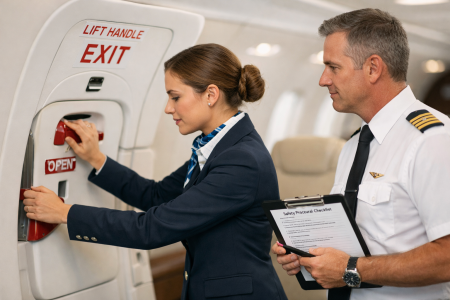
- Location and operation of emergency exits, including evacuation slides and escape ropes
Each of these areas must appear in the operator’s annual flight attendant recurrent training testing protocol. An operator that tests only a subset is not in compliance.
Part 91K and Part 91: How Flight Attendant Training Requirements Differ
Not every corporate flight attendant operates under Part 135. Part 91K flight attendant training requirements depend on an FAA-approved program structure and the specific aircraft and operation rather than a single universal standard. Recurrent intervals, content scope, and testing requirements are governed by the program’s approved training curriculum and the operator’s operational specifications.
For pure Part 91 operations, there is no explicit FAA-mandated cabin crew recurrent training requirement equivalent to Part 135. However, the absence of a federal mandate does not mean training is unnecessary. Many Part 91 operators voluntarily adopt recurrent training standards driven by insurance requirements, safety management commitments, or adherence to voluntary frameworks such as IS-BAO.
The misconception that “Part 91 means no cabin training requirements” is dangerously oversimplified. Operators who move aircraft between Part 91 and Part 135 — a common configuration in business aviation — must ensure that flight attendants serving on Part 135 flights meet full Part 135 recurrent training and currency standards, even if those same individuals fly Part 91 legs where no mandate applies.
What Must Part 135 Flight Attendant Recurrent Training Cover?
A compliant and operationally effective corporate flight attendant training program goes beyond the bare regulatory minimum. FAA certification guidance outlines multiple required curriculum segments for Part 135 operators, and a well-designed program organizes these into a modular architecture. Core content areas include:
- Emergency evacuation procedures — land and water evacuation, exit operation, passenger flow management
- Fire and smoke response — portable fire extinguisher use, smoke management, cockpit coordination
- Oxygen system operation — supplemental and emergency oxygen deployment, passenger oxygen units
- First aid and medical emergencies — AED use, passenger incapacitation, in-flight medical event response
- Passenger management under duress — unruly passengers, special-needs passengers, crowd control during evacuation
- Cabin resource management — communication between cabin and cockpit, threat recognition, team coordination
- Regulatory and SOP updates — annual regulatory changes, operator-specific procedure revisions
- Aircraft-specific cabin systems — installed equipment, cabin layout, galley systems, emergency equipment locations
- Passenger briefing requirements — pre-departure briefings, safety demonstrations, special briefing scenarios
- Emergency equipment proficiency — location, operation, and inspection of all installed emergency equipment
Flight attendant emergency training covers evacuation, fire and smoke, oxygen, first aid, and passenger management — it is not equivalent to basic first aid certification alone. This is one of the most frequently misunderstood aspects of flight attendant annual training.
Emergency Training vs. General Safety Refreshers
Flight attendant emergency training under Part 135 is a distinct regulatory element. It encompasses far more than CPR and bandaging. The FAA expects demonstrated competency in emergency evacuation procedures, fire and smoke management in a pressurized cabin, emergency oxygen deployment, operation of all installed emergency equipment, and passenger management under high-stress conditions.
Scenario-based training makes these competencies tangible. Consider sudden decompression at altitude: the cabin crew must deploy oxygen, manage disoriented passengers, and coordinate with the flight deck — simultaneously. Or an aborted takeoff with smoke in the cabin: the FA must initiate an evacuation using the correct exits for that specific aircraft, manage passenger movement in reduced visibility, and operate fire extinguishers if required. These are not theoretical exercises — they are the emergencies that recurrent training exists to prepare for. The FAA Advisory Circular AC 120-101 provides additional guidance on developing effective cabin safety training programs.
Aircraft-Specific and Operator-Specific Modules
One-size-fits-all training is insufficient for compliance. Operators with customized interiors, supplemental type certificates (STCs), medical equipment installations, or non-standard cabin controls need recurrent modules tailored to those specifics. A flight attendant trained on a standard interior may not be proficient on the same airframe with a custom medical-transport configuration.
Operator specifications (OpSpecs) govern aircraft-specific and operation-specific training content. When an operator modifies an interior or adds equipment, the recurrent training program must reflect those changes — and it is exactly the type of gap an FAA inspector will identify during surveillance.
Online, In-Person, or Blended: Choosing the Right Delivery Model for Recurrent Training
Can FAA-approved flight attendant recurrent training online satisfy Part 135 requirements? The answer is partially yes — but with important limitations.
Knowledge-based portions of recurrent training are well suited for online delivery. Topics such as regulatory updates, passenger handling procedures, emergency equipment location reviews, oxygen system theory, and cabin resource management fundamentals can be delivered via e-learning, provided the operator’s FAA-approved training program permits it. FAA-approved program structures separate ground knowledge from demonstrated performance, which directly supports the blended delivery model.
However, hands-on skills cannot be replaced by computer-based training alone. Evacuation drills, fire extinguisher operation, smoke drill procedures, oxygen deployment practice, AED and first aid procedures, and emergency exit operation must be practiced physically. The FAA expects operators to verify proficiency through practical exercises — not multiple-choice questions alone.
The blended model also addresses a real operational constraint in corporate aviation: scheduling. Flight attendants in business aviation often work irregular schedules across multiple time zones. Completing knowledge modules online between trips — then consolidating hands-on training into focused practical sessions — reduces scheduling friction without compromising regulatory integrity. The key is ensuring your FAA-approved training program explicitly authorizes online delivery for specific modules and maintains clear documentation of both knowledge and practical completion.
Recordkeeping, Audit Readiness, and Common Compliance Pitfalls
Training documentation, expiration tracking, and proof of completion are consistently identified as high-risk areas in FAA Part 135 surveillance. Training systems should track validity tied to the beginning of the 12th calendar month — not rely on approximate scheduling. “About a year ago” is not a defensible compliance position.
What happens if a corporate flight attendant misses the 12-month recurrent training window? The answer is unambiguous: the FA cannot legally serve as a required crewmember until flight attendant recurrent training is completed. Experience does not substitute for currency. The 12-month requirement applies regardless of seniority or total flight hours.
The most common compliance pitfalls include:
- Misunderstanding the calendar-month rule — calculating currency from the training date rather than the beginning of the training month
- Incomplete records for FAs who work across multiple operators — assuming training completed for one certificate holder satisfies another’s approved program
- Failing to document aircraft-specific training when interiors are modified — the training record must reflect the current cabin configuration
- Treating experienced FAs as exempt from recurrent requirements — the regulation makes no exception for seniority
- Confusing attendance with tested competency — §135.293 requires testing, not just participation
Operators who are uncertain about their currency tracking should audit their training records against the 12-calendar-month rule now — before an FAA inspector does it for them. CTS Part 135 Training provides a structured framework to help operators identify and close these gaps.
Building a Stronger Flight Attendant Recurrent Training Program
Compliance is the floor, not the ceiling. The most effective flight attendant recurrent training programs integrate SMS-style thinking: scenario-based exercises, threat recognition drills, decision-making under pressure, and structured communication between cabin and cockpit crews. Business aviation safety organizations treat cabin safety as a system issue best addressed through integrated training — not isolated annual events.
A modular curriculum architecture gives operators the flexibility to update individual modules — regulatory changes, aircraft-specific updates, SOP revisions — without rebuilding the entire program. When cabin training is integrated with cockpit SOPs and operator-specific cabin layouts, the entire crew operates from a shared framework during both normal and emergency operations. The IS-BAO standards published by IBAC offer an additional voluntary framework many business aviation operators use to benchmark their training programs against industry best practices.
The difference between a compliant program and an effective one often comes down to curriculum design, modular flexibility, and integration with the operator’s specific aircraft and SOPs. CTS offers FAA-informed Part 135 and IS-BAO/Part 91 training packages designed for corporate and charter cabin crews. Explore the CTS Part 135 Training and IS-BAO/Part 91 Training programs to see how modular, scenario-based courseware can strengthen your compliance posture and your crew’s real-world readiness.
Frequently Asked Questions About Flight Attendant Recurrent Training
How often are flight attendants required to complete recurrent training under Part 135?
Every 12 calendar months per 14 CFR §135.343. The currency window is measured from the beginning of the calendar month in which training was completed — not the exact training date. Training completed on June 20 establishes currency from the beginning of June, expiring at the end of May the following year.
What topics must be covered in Part 135 flight attendant recurrent training?
Section 135.293 requires testing in at least eight competency areas: PIC authority, passenger handling, ditching and evacuation, passenger briefings, fire extinguishers, emergency cabin equipment, oxygen systems, and emergency exits. CRM and emergency training are also required curriculum segments under §135.329. The operator’s FAA-approved training program may include additional topics based on aircraft type and operational scope.
Can Part 135 flight attendant recurrent training be completed online?
Knowledge-based modules can be delivered online if the operator’s FAA-approved training program permits it. However, hands-on skills — evacuation drills, fire extinguisher use, smoke drills, oxygen deployment, and exit operation — must be practiced in person. CTS provides online training modules that can serve as the knowledge component of a blended recurrent program.
Does Part 91 require flight attendants to complete recurrent training?
Part 91 does not have an explicit FA recurrent training mandate equivalent to Part 135. However, many Part 91 operators voluntarily adopt structured recurrent training standards aligned with IS-BAO or similar frameworks. Part 91K fractional programs operate under FAA-approved training structures with recurrent requirements that depend on the approved program and aircraft specifics.
What happens if a corporate flight attendant misses the 12-month recurrent training window?
The flight attendant cannot legally serve as a required crewmember until recurrent training is completed. Experience does not substitute for currency — the 12-month requirement under §135.343 applies regardless of seniority or total flight time.