Traffic Awareness in 2026: ADS-B In, TAS, and What NTSB Recommendation A-26-31 Means for Your Fleet
An ADS-B In system could have given the cockpit crew its first audible traffic advisory system alert 59 seconds before impact in the January 2025 Washington-area midair collision—59 seconds the crew never had. According to NTSB analysis of the accident (investigation DCA25MA108), that finding is at the heart of NTSB Recommendation A-26-31. In September 2026, the NTSB publicly declared the FAA’s response to it “unacceptable.”
The recommendation’s core ask is direct: all aircraft operating in airspace where ADS-B Out is already required should also carry ADS-B In equipment configured to provide a cockpit display of traffic information and audible alerting. For fleet operators and training managers, the recommendation redefines what a traffic advisory system should deliver in the cockpit. It is not yet a rule—but the NTSB’s public criticism of the FAA’s responses signals that the current status quo is under sustained pressure.
This article breaks down what NTSB A-26-31 actually says, how ADS-B In fits alongside TAS, TCAS, and ACAS X, where the FAA’s regulatory posture stands today, and what fleet operators and training managers should do now—before a formal mandate forces their hand.
What NTSB Recommendation A-26-31 Actually Says
In plain operational language, A-26-31 recommends that every aircraft operating in airspace governed by the existing ADS-B Out mandate (14 CFR 91.225 and 91.227) also carry ADS-B In equipment. That equipment must be configured to provide two things: a cockpit traffic display showing nearby ADS-B-equipped aircraft, and audible alerting capable of notifying the pilot or flight crew of traffic conflicts.
The scope is enormous. The recommendation covers the entire population of aircraft subject to ADS-B Out requirements—a fleet far larger than the subset currently required to carry TCAS or any other traffic awareness system aircraft operators typically associate with collision avoidance. It would extend cockpit traffic alerting capability to general aviation aircraft, light turboprops, and a wide range of Part 91 and Part 135 operations that have never been required to carry active traffic-alerting equipment.
A-26-31 emerged from a package of 33 total safety recommendations the NTSB issued after the January 2025 Washington-area midair collision (DCA25MA108). In September 2026, the NTSB publicly classified 11 of the FAA’s 33 responses as “unacceptable,” and A-26-31 was specifically singled out as a major point of contention. The NTSB’s stated position is that ADS-B In would provide an “immediate and substantial” safety benefit, especially near airports where see-and-avoid has known limitations.
The 59-second warning window is the statistic that anchors the NTSB’s urgency. According to NTSB analysis, an ADS-B In traffic display with audible alerting could have delivered the first cockpit traffic alert nearly a full minute before the collision—time the crew did not have with the equipment on board. That finding underpins the NTSB’s argument that voluntary adoption is not moving fast enough.
It is critical to note: A-26-31 is a safety recommendation, not a binding FAA rule. As of late 2026, no regulatory mandate exists. But the NTSB’s willingness to publicly label the FAA’s response “unacceptable” is an unusually strong regulatory signal.
ADS-B Out vs. ADS-B In: Why the Distinction Matters Now
The confusion between ADS-B Out and ADS-B In persists across the industry, and it has real operational consequences. ADS-B Out broadcasts your aircraft’s position, velocity, and identification to ground stations and other aircraft. It has been required since January 2020 in most controlled airspace under 14 CFR 91.225 and 91.227. If your aircraft operates in Class A, B, or C airspace—or above 10,000 feet MSL—it almost certainly transmits ADS-B Out.
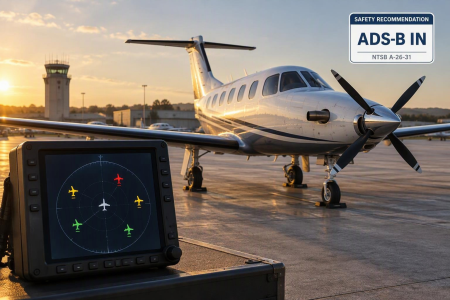
But carrying ADS-B Out does not mean your aircraft can see other traffic via ADS-B. That is the function of ADS-B In, which receives traffic and weather data for display on a cockpit display of traffic information (CDTI). Many operators assume that because they broadcast, they also receive. They do not—unless separate ADS-B In equipment is installed.
A-26-31 is specifically about closing this gap. The NTSB’s position is that an aircraft broadcasting its own position into the NextGen airspace system should also be able to receive and be alerted to traffic around it. FAA AC 20-172B provides airworthiness guidance for ADS-B In installations, but the AC frames those display applications as supporting “basic situational awareness only”—not collision avoidance. The distinction between broadcasting and receiving is not academic. It is the operational reality at the center of this debate.
TAS vs. TCAS vs. ADS-B In vs. ACAS X: A Traffic Advisory System Comparison
System | What It Does | Alert Type | Typical Aircraft Class | Current Mandate Status |
|---|---|---|---|---|
Traffic Advisory System (TAS) | Interrogates transponders of nearby aircraft; displays relative position to help pilots visually acquire traffic | Traffic advisories only—no resolution advisories (no climb/descend commands) | Turboprops, light jets, Part 135 and Part 91 fleets | Not universally mandated; installed voluntarily or per operator requirements |
TCAS II | Interrogates transponders; provides both traffic advisories and resolution advisories (coordinated climb/descend commands) | Traffic advisories and resolution advisories | Air carrier aircraft with 30+ passenger seats or meeting MTOW thresholds | Mandated for applicable aircraft under TCAS II equipage rules |
ADS-B In with Traffic Display | Receives ADS-B traffic data from nearby aircraft and ground stations; displays traffic on a cockpit screen; advanced implementations add audible alerting | Situational awareness per FAA AC 20-172B (“basic situational awareness only”); audible alerting in some configurations | Broad—applicable from general aviation through Part 135 and Part 121 fleets | Not mandated; subject of NTSB Recommendation A-26-31 |
ACAS X (Xa / Xu) | Next-generation airborne collision avoidance system family; ACAS Xa replaces TCAS II for manned aircraft, ACAS Xu designed for UAS integration | Traffic advisories and resolution advisories (improved logic over TCAS II) | Large transport aircraft (Xa); UAS (Xu) | A separate NTSB companion recommendation calls for the appropriate ACAS X variant on new production aircraft subject to TCAS equipage rules |
These systems are complementary, not interchangeable. The term “traffic advisory system” now encompasses a broader ecosystem than it did a decade ago—spanning passive displays, active interrogation-based alerting, and satellite-derived traffic feeds. A chief pilot evaluating fleet equipage needs to understand how these layers interact in the cockpit. Assuming that one system replaces another is a documented false-confidence trap: a TAS does not provide resolution advisories, an ADS-B In display does not see non-ADS-B-equipped targets, and TCAS II does not display ADS-B traffic data unless integrated with a separate receiver. Each fills a different role in midair collision prevention.
Where the FAA Stands: AC 20-172B and the Regulatory Gap
FAA Advisory Circular 20-172B is the primary airworthiness guidance for ADS-B In installations and the applications they support. The AC covers initial and follow-on installations of ADS-B In systems that provide ground and airborne traffic information to the cockpit. Its language is careful: the supported display applications are designed for “basic situational awareness only.”
That phrasing carries significant weight. Even if an operator installs ADS-B In today with a full cockpit traffic display and audible alerting capability, the FAA’s current certification philosophy does not treat it as a collision-avoidance system. It is a situational awareness tool—valuable, but not a substitute for ATC separation, TCAS resolution advisories, or disciplined visual scanning.
Here lies the regulatory gap. The NTSB’s A-26-31 calls for ADS-B In with audible alerting—implying a level of operational reliance that the FAA’s existing guidance does not yet support. The FAA has not rejected ADS-B In; it has framed it conservatively. For fleet operators, this creates a planning challenge: investing in ADS-B In now is prudent, but crews must be trained to understand the system’s certified limitations, not its theoretical capabilities. The gap between what ADS-B In can do and what the FAA currently approves it for is where operational risk lives. For additional regulatory context, the NTSB’s full investigation record for DCA25MA108 provides the primary source documentation behind A-26-31.
What This Means for Your Fleet: Traffic Advisory System Training and Equipage Decisions
The regulatory signal is clear even if the timeline is not. Fleet operators face three immediate operational realities.
Crew Training Must Go Beyond Button-Pushing
Training programs must teach traffic-information interpretation, not just equipment operation. Crews need to understand what a cockpit traffic display does and does not show: non-ADS-B-equipped aircraft will not appear, ground vehicle clutter may cause confusion near airports, and alerting logic varies between systems. The human-factors risk of overtrust is well documented—more traffic data does not always mean better safety if crews lack the training to interpret it correctly.
Scenario-based training should include false-confidence traps: situations where a clean traffic display masks a real threat from a non-equipped aircraft, or where an audible traffic alert demands a different crew response than a visual-only advisory. Training must distinguish between advisory-only systems and audible-alerting systems in terms of expected crew workflow and decision-making. AOPA’s Air Safety Institute offers supplemental human-factors resources that contextualize see-and-avoid limitations and traffic-display overtrust risks.
Mixed Fleets Need Standardized Workflows
Operators flying mixed fleets—where traffic-awareness capabilities vary by tail number—face a specific crew-workflow challenge that few industry resources address directly. One aircraft may have a full ADS-B In display with audible alerting; the next may rely on TAS alone; a third may have no cockpit traffic display at all.
The practical solution is to standardize crew actions around the lowest-common-denominator workflow. Pilots transitioning between aircraft with different traffic-display capabilities must maintain consistent visual scanning discipline and ATC coordination habits regardless of what is on the panel. The display is an aid, not a replacement for procedure. Operators flying under Part 135 can explore CTS’s Part 135 Training package for curriculum resources that address traffic-awareness procedures alongside other regulatory requirements.
Planning for Equipage Before the Mandate Arrives
A-26-31 is a planning signal. No one can predict the FAA’s rulemaking timeline with certainty, but the NTSB’s sustained public pressure—combined with the political backdrop of the Washington-area collision—makes inaction increasingly difficult to justify to leadership and safety boards. Operators who begin evaluating ADS-B In installations and updating their training curricula now will avoid a fleet equipage compliance scramble if and when a final rule is issued.
The ADS-B Out mandate offers a cautionary precedent: operators who waited until the last months before the January 2020 deadline faced equipment shortages and scheduling bottlenecks. Starting the evaluation process now—assessing avionics options, budgeting for installations, and updating training syllabi—is a measured response to a credible regulatory signal. For Part 91 and IS-BAO operators evaluating training updates, CTS’s IS-BAO/Part 91 Training package provides a structured starting point.
Frequently Asked Questions
What is a traffic advisory system and how does it differ from TCAS?
A traffic advisory system (TAS) is an aircraft avionics system that interrogates transponders of nearby aircraft to display their relative position and issue traffic advisories, helping pilots visually acquire potential conflicts. Unlike TCAS II, a TAS does not issue resolution advisories and will not command a climb or descent. TAS is typically installed on smaller aircraft such as turboprops and light jets, while TCAS II is mandated on larger transport-category aircraft meeting passenger-seat or weight thresholds.
Is ADS-B In required by the FAA in 2026?
No. As of late 2026, ADS-B In is not mandated by the FAA. NTSB Recommendation A-26-31 calls for such a requirement, but it remains a safety recommendation, not a binding rule. FAA AC 20-172B provides airworthiness guidance for operators who choose to install ADS-B In voluntarily.
What does NTSB Recommendation A-26-31 recommend for aircraft operators?
NTSB A-26-31 recommends—it does not require—that all aircraft operating in airspace where ADS-B Out is mandated also carry ADS-B In equipment with a cockpit traffic display configured for audible alerting. Because it is an NTSB recommendation and not an FAA rule, it carries no current enforcement authority. However, 11 of 33 FAA responses to the recommendation package were deemed “unacceptable” by the NTSB in September 2026, indicating sustained pressure for action.
Can ADS-B In prevent midair collisions or is it only for situational awareness?
FAA AC 20-172B currently certifies ADS-B In display applications for basic situational awareness only, not as a standalone collision-avoidance system. However, the NTSB argues that the added awareness—especially with audible alerts—could provide critical warning time. In its analysis of the Washington-area collision, the NTSB found that an ADS-B In system could have provided a 59-second alert window before impact, time the crew did not have with existing equipment.
What training do pilots need for cockpit traffic advisory systems?
Pilots need training covering traffic-information interpretation, system limitations, the difference between advisory-only and alerting systems, and proper visual scanning discipline. Training should address the risk of overtrust in traffic displays—a clean screen does not mean clear airspace if non-equipped aircraft are present. Scenario-based exercises for mixed-equipage environments help crews maintain consistent workflow regardless of which aircraft they are flying.
The Bottom Line
NTSB A-26-31 is not yet law, but it is the clearest signal the NTSB has sent about the future of cockpit traffic advisory system requirements in U.S. airspace. Operators who treat it as a planning baseline—updating training curricula, evaluating ADS-B In installations, and standardizing crew workflows across mixed fleets—will be positioned ahead of the curve when regulatory action arrives. The 59-second warning window that could have existed in the Washington-area collision is a stark reminder that a traffic advisory system is only as effective as the crew trained to use it.
CTS offers online training resources designed to close that gap. Review CTS’s ADS-B Overview Online Aviation Training Course to ensure your crews understand the operational differences between ADS-B Out, ADS-B In, and cockpit traffic displays before the next regulatory update.