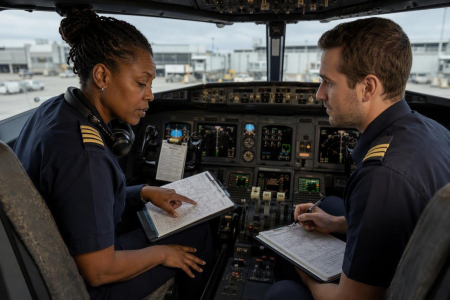
Crew Resource Management (CRM): Principles, TEM, and Why It Still Matters
If human error remains a factor in the majority of aviation accidents, why do some operators still treat crew resource management training as a checkbox exercise? FAA Part 135 now mandates CRM training across eight core topic areas, and EASA is pushing further still — requiring measurable performance outcomes rather than attendance alone. Crew resource management is a human factors framework for using all available resources — people, procedures, and information — to operate safely and efficiently. It is not a formality. It is a living safety system. This article covers CRM principles, Threat and Error Management (TEM), regulatory requirements under FAA and EASA rules, and what modern training design must look like to produce genuine behavioral change. In an era of increasing automation and operational complexity, CRM’s relevance is growing, not shrinking.
What Is Crew Resource Management?
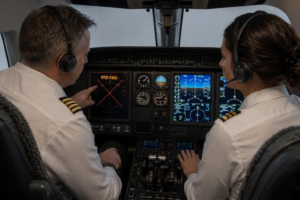
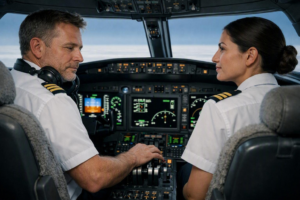
Crew resource management is a human factors and non-technical skills framework focused on how crews use all available resources to operate safely and efficiently. Those resources include people, procedures, equipment, and information. CRM in aviation addresses the reality that technical proficiency alone does not prevent accidents — crews must also communicate effectively, manage workload, maintain situational awareness, and make sound aeronautical decisions under pressure.
CRM in aviation is not limited to cockpit etiquette or a single annual training event. It is a systematic approach to managing human limitations and operational complexity across every phase of flight. The concept originated as “cockpit resource management” in the late 1970s, born from accident investigations that revealed technically competent crews failing due to poor communication, rigid authority gradients, and breakdowns in teamwork.
The shift from “cockpit” to “crew” resource management was deliberate. CRM applies beyond the flight deck to cabin crew, dispatchers, maintenance controllers, and other operational personnel whose actions directly affect flight safety. A flight attendant who identifies a safety concern during boarding, a dispatcher who flags deteriorating weather — these are CRM functions. When we limit CRM to pilots only, we ignore the broader operational system that determines whether a flight operates safely.
Modern CRM programs treat non-technical skills — communication, leadership, decision-making, mutual monitoring — as trainable competencies with observable standards, not personality traits that crews either possess or lack.
Core Principles of Crew Resource Management
The core principles of crew resource management form the backbone of every effective CRM training program. These are not abstract theories. They are actionable skills that crews apply on every flight, from preflight briefing through shutdown. FAA Part 135 mandates at least eight required CRM topic areas, and each one addresses a specific dimension of crew performance.
- Communication and Standard Callouts: Clear, concise flight deck communication prevents misunderstandings. Standard callouts create predictable crew coordination and reduce ambiguity during critical phases of flight.
- Authority Gradient Management: An overly steep authority gradient — where the captain’s word goes unchallenged — is a known accident precursor. Modern CRM expects crews to flatten the gradient appropriately so that first officers, flight engineers, and cabin crew speak up when they identify a threat or error.
- Situational Awareness: Crews must maintain a shared mental model of the aircraft’s state, the environment, and what comes next. Loss of situational awareness is among the most cited factors in incident reports.
- Workload and Time Management: Effective workload management means distributing tasks, prioritizing actions, and avoiding task saturation — especially during high-demand phases like approach and landing.
- Aeronautical Decision-Making: CRM frames aeronautical decision-making as a crew function, not a solo act. Coordinated decision-making — where crew members contribute information, challenge assumptions, and confirm plans — produces better outcomes than command authority alone.
- Team Building and Mutual Monitoring: Crews who actively monitor each other’s actions catch errors earlier. Mutual monitoring is not distrust; it is professionalism.
- Fatigue and Stress Management: CRM acknowledges that fatigue and stress degrade performance. Training addresses recognition, reporting, and mitigation strategies.
- Speak-Up Culture: Junior crew members must be empowered — and expected — to challenge when they see something wrong. A safety culture in aviation depends on the organizational willingness to hear bad news before it becomes an accident.
CRM vs. TEM: Understanding the Relationship
CRM and threat and error management are related but not the same thing, and conflating them weakens both concepts. Crew resource management is the broader teamwork and resource-use framework. Threat and error management (TEM) is the operational method for managing threats and errors within that framework.
CRM provides the skills — communication, situational awareness, decision-making, mutual monitoring. TEM provides the structure for applying those skills to real operational risk. TEM gives crews a common language: threats are conditions that increase complexity or risk; errors are crew actions that deviate from intentions or standards; and an undesired aircraft state is a position, speed, attitude, or configuration that reduces safety margins.
Training organizations consistently describe TEM as the practical bridge between CRM theory and line operations. Without TEM, crew resource management remains a set of principles. With TEM, crews have a decision framework they can apply from preflight planning through shutdown.
How TEM Works in Practice
Consider a line-operations scenario that illustrates the TEM chain — a practical CRM aviation example of how these concepts apply in real operations:
- Threat Identification: During the preflight briefing, the crew identifies convective weather building along the arrival route. They discuss contingency approaches and brief the go-around procedure with extra emphasis. The threat is anticipated before the aircraft leaves the gate.
- Error Detection: On the approach, the pilot monitoring notices an incorrect altitude set in the MCP — a procedural error. The standard callout catches it immediately. The error is trapped before it propagates.
- Recovery from an Undesired Aircraft State: Despite briefing, turbulence and a late runway change destabilize the approach. The aircraft is high and fast inside the final approach fix — an undesired aircraft state. The crew executes a go-around without hesitation, following their briefed procedure. The undesired state is resolved before it becomes an incident.
This is TEM in action: anticipate, trap, recover. Each step depends on the CRM skills that make it possible — communication, mutual monitoring, and coordinated aeronautical decision-making.
Regulatory Requirements for CRM Training
Crew resource management training is not optional for commercial operators. The regulatory framework across FAA, EASA, and ICAO establishes clear CRM training requirements — and those requirements are evolving toward higher standards of accountability.
FAA CRM Requirements (Part 121 and Part 135)
Under 14 CFR §135.330, each Part 135 certificate holder must maintain an approved CRM training program that includes both initial and recurrent training. The regulation specifies at least eight required topic areas:
- Authority of the pilot in command
- Communication and coordination
- Building and maintaining a flight team
- Workload and time management
- Situational awareness
- Effects of fatigue on performance
- Effects of stress on performance
- Aeronautical decision-making
After March 22, 2013, no Part 135 certificate holder may use a flightcrew member or flight attendant who has not completed approved CRM initial training. FAA Advisory Circular 120-51E serves as the primary FAA CRM guidance document, providing detailed implementation guidance for both Part 121 and Part 135 operators.
For operators building or updating a Part 135-compliant training program, CTS offers a comprehensive Part 135 training package designed to meet these requirements.
EASA and ICAO CRM Standards
EASA has moved crew resource management firmly into the competency-based training ecosystem. Under AMC1 ORO.FC.115, EASA supports a competency-based CRM approach aligned with evidence-based training, emphasizing observable performance outcomes rather than hours in a classroom. EASA’s 2026 rulemaking activity — including Opinions 01/2026 and 02/2026 — signals ongoing modernization of air operations and training requirements, reinforcing the direction toward performance-oriented competence management. These opinions address broader air operations rule updates; their CRM implications are part of a wider regulatory modernization trend rather than CRM-specific mandates.
ICAO CRM doctrine remains the global reference standard. Industry summaries describe modern CRM curricula as aligned to nine ICAO core competencies, which integrate communication, teamwork, leadership, decision-making, situation awareness, workload management, flight path management, and other performance domains. These competencies provide the foundation that national regulators build upon.
Why Crew Resource Management Still Matters: Automation, Culture, and Evolving Threats
Some operators treat CRM as a legacy concept — something that mattered when captains ruled the cockpit unchallenged but is less relevant in modern, highly automated flight decks. This view is wrong, and dangerously so.
Automation dependency has introduced entirely new error modes. Mode confusion, automation surprise, and degraded monitoring during low-workload cruise phases are real threats that crew resource management must address head-on. High-automation cockpits demand more situational awareness, not less, because the consequences of losing the shared mental model are harder to recover from at speed.
Cultural evolution remains an ongoing challenge. Flattening the authority gradient is not a solved problem — it requires continuous reinforcement, especially across diverse crew compositions where cultural norms around hierarchy vary significantly. A speak-up culture does not sustain itself. It must be trained, practiced, and protected through recurrent exercises that make challenge-and-response behaviors feel normal, not adversarial.
Evolving operational complexity — new airspace procedures, increasing traffic density, and expanded CRM expectations beyond the cockpit — means the scope of crew resource management continues to grow. Some industry sources cite that CRM training can reduce human-error-related accidents by up to 55%, though this figure has not been independently verified and should be treated with caution. What is well established is that CRM does not eliminate human error. It reduces the likelihood that errors become accidents by improving detection and recovery. That distinction matters, and it is reason enough to invest in programs that drive real behavioral change.
Building Effective CRM Training Programs
Regulatory compliance is the floor, not the ceiling. Training managers who want crew resource management programs that actually change crew behavior must go beyond passive slide-based content and attendance tracking.
Realistic scenario-based training is the foundation. Effective CRM training uses line-oriented exercises, interactive branching scenarios, short decision points, and structured debriefing. Crews should practice error trapping in context — not just learn about it from a slide deck. Line-oriented flight training that integrates TEM scenarios forces crews to apply communication, workload management, and aeronautical decision-making under realistic pressure.
E-learning complements but does not replace hands-on practice. Online modules work well for knowledge refreshers, policy reinforcement, and scenario priming. They scale efficiently for recurrent CRM training. But e-learning alone does not produce behavioral change. It must be paired with simulator sessions or line-oriented practice where crews demonstrate competency under observation.
Threat and error management should be taught as a continuous decision framework — not an isolated module. Crews should learn to identify threats early, prevent errors where possible, detect errors quickly when they occur, and recover from undesired aircraft states before they escalate. TEM should appear in every phase of training, not just a standalone lesson.
Automation management deserves explicit attention as a CRM training topic. Mode confusion, monitoring system behavior, maintaining situational awareness in glass cockpits — these are CRM competencies that modern programs must address directly.
Recurrent training is where crew resource management lives or dies. A one-time initial course fades. Ongoing reinforcement with culturally safe challenge-and-response exercises builds the habits that hold up under pressure.
Designing CRM E-Learning That Works
Most CRM e-learning fails because it relies on static slides and multiple-choice quizzes that test recall, not judgment. Effective CRM e-learning uses case-study-driven modules where learners face realistic decisions. Interactive branching scenarios — where a learner’s choice changes the outcome — build the pattern recognition that crew resource management demands.
Short decision checkpoints throughout each module keep engagement high. Post-module debriefs that explain why certain choices led to better outcomes reinforce the connection between CRM principles and operational performance. The critical gap most training programs fail to close is pairing this e-learning with hands-on practice — simulator sessions, tabletop exercises, or facilitated group debriefs.
Well-designed CRM e-learning, when combined with scenario-based practice and structured debriefs, bridges the gap between regulatory compliance and genuine behavioral change. For training managers who want a program that meets both FAA and EASA standards while driving real crew performance, explore CTS’s CRM & ADM training course to build crew resource management skills that translate to measurable safety performance in line operations.
Common CRM Misconceptions
- “CRM is just cockpit etiquette.” Crew resource management is a safety system for managing human limitations, operational complexity, and error recovery. It is far more than being polite on the flight deck.
- “CRM is only for pilots.” CRM applies to cabin crew, dispatchers, and operational personnel whose coordination directly affects flight safety. The regulations reflect this — FAA Part 135 requires CRM training for flight attendants as well.
- “CRM is a one-time course.” Crew resource management requires both initial and recurrent training. Regulatory requirements and operational best practice demand ongoing reinforcement.
- “TEM is just another name for CRM.” Threat and error management is the operational risk management method within the broader CRM framework. CRM provides the skills; TEM provides the structure for applying them.
- “Good CRM means the captain always decides alone.” Modern crew resource management in aviation expects challenge, cross-checking, and coordinated decision-making. Command authority remains with the PIC, but effective captains actively seek crew input.
- “CRM eliminates human error.” CRM does not eliminate error. It improves detection and recovery so that errors are trapped before they become incidents or accidents.
Frequently Asked Questions About Crew Resource Management
What is crew resource management in aviation?
Crew resource management is a human factors and non-technical skills framework focused on how crews use all available resources — people, procedures, and information — to operate safely and efficiently. It addresses communication, situational awareness, aeronautical decision-making, workload management, and teamwork across the flight deck, cabin, and operational support functions.
What are the core principles of crew resource management?
Core CRM principles include communication and standard callouts, authority gradient management, situational awareness, workload and time management, aeronautical decision-making, team building and mutual monitoring, fatigue and stress management, and speak-up culture. FAA Part 135 requires CRM training in at least eight major topic areas that align with these principles.
How does threat and error management relate to CRM?
TEM is the operational method used within the crew resource management framework to manage risk in real time. While CRM provides the broader teamwork and resource-use skills, TEM gives crews a structured approach: anticipate threats, detect and trap errors, and recover from undesired aircraft states before they escalate.
What does FAA regulation say about crew resource management training?
Under 14 CFR §135.330, FAA requires Part 135 certificate holders to maintain an approved CRM training program covering eight topic areas, including communication, situational awareness, workload management, fatigue, stress, and aeronautical decision-making. After March 22, 2013, no certificate holder may use a flightcrew member or flight attendant who has not completed approved CRM initial training.
What is the difference between CRM and TEM in aviation?
CRM is the broader framework encompassing teamwork, communication, aeronautical decision-making, and resource management skills. TEM is a specific operational method within crew resource management that focuses on identifying threats, trapping errors, and recovering from undesired aircraft states. Industry summaries describe modern CRM curricula as aligned to nine ICAO core competencies, integrating TEM as the practical application of CRM principles during line operations.
Looking for CRM training that goes beyond slides? See how CTS structures its CRM and ADM course around interactive scenarios and measurable competencies.