What an FAA Ramp Check Really Covers: Part 135 Training Records, 135.63, and What Lives Where
Consider a hypothetical: a Part 135 captain is finishing a preflight during an FAA ramp check at an outstation when an inspector presents credentials and asks about the crew’s training. The captain’s first thought is that the training file isn’t in the airplane. Under 14 CFR 135.63, that instinct is correct.
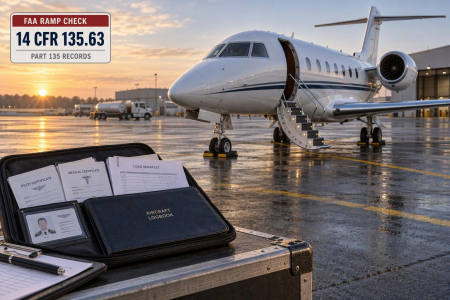
Part 135 training records belong to the certificate holder, not the cockpit. Section 135.63 places pilot records at the operator’s principal business office or another FAA-approved location, where they must be made available for inspection. They are generally not a standard onboard document. The crew’s exposure on the ramp centers on personal and aircraft documents. The operator’s exposure for training records sits in the office file, which can be examined in a separate records inspection.
The FAA’s emergency revocation action against StarFlite Aviation’s certificate in February 2026 shows why the integrity of that file matters. What follows works through the four pieces in order: personal documents, aircraft documents, operator records, and how to prepare.
FAA ramp check or records inspection: two different events
A ramp inspection examines the aircraft and the operation as it happens. FAA surveillance guidance also describes dedicated inspections of crewmember and dispatcher records. Those are separate events with separate scopes, and treating them as one can leave the office file under-prepared.
FAA Order 8900.1, Volume 6, Chapter 2, Section 5 states that the ramp inspections it covers include, at a minimum, examination of registration, the Airworthiness Certificate, and the maintenance logbook. Two qualifiers apply. Order 8900.1 is inspector guidance, not a regulation. That section also addresses ramp inspections on cargo loading specifically. It still shows where an inspector’s attention typically starts: the aircraft’s documents.
Authority to inspect is broad. Section 135.73 requires the certificate holder and its employees to allow the FAA to make inspections or tests at any time or place. Under 135.75, an inspector who presents FAA Form 110A is given access to the pilot compartment, though the PIC keeps emergency authority to exclude any person when safety requires it.
No regulation or guidance in the research provides a fixed question list for every ramp check. The scope of an FAA surveillance inspection depends on its purpose, so an inspector’s document request is best met by a crew that understands categories rather than one that has memorized a script.
What an inspector can ask to see during an FAA ramp check
Crews asking what documents are required for an FAA ramp check should start with the operating rule for the flight. Part 125 and Part 91K have different onboard provisions from Part 135, so a single generic list will mislead. For a Part 135 flight, the onboard material falls into two groups.
Your personal documents
- Pilot certificate possession under 61.3(a): a required pilot flight crewmember must have the appropriate pilot certificate and qualifying photo ID in physical possession or readily accessible in the aircraft.
- The medical certificate requirement under 61.3(c), subject to the exceptions stated in the rule.
- For Part 135 and 91K operations, 61.3 recognizes certain temporary verification documents under an approved certificate verification plan.
The logbook is a common misconception. Section 61.51 requires pilots to log specified experience and present Part 61 records on reasonable request, but it does not require carrying a complete personal logbook on every flight. Specific exceptions exist, such as certain student solo cross-country flights. Either way, the personal logbook is separate from the operator’s training file.
The aircraft’s documents
- Airworthiness and registration certificates within the aircraft under 91.203, with the airworthiness certificate displayed as the rule specifies.
- The aircraft maintenance log, carried onboard under 135.65.
- Current operating information accessible to the pilot at the pilot station under 135.83, including checklists, charts, and one-engine-inoperative performance data where applicable.
- For multiengine aircraft only, the load manifest copy the PIC carries to destination under 135.63(c) and (d). It covers passenger count, weight and center of gravity, registration or flight number, origin and destination, and crew identification and positions.
Manuals are often misunderstood. Section 135.21 requires relevant portions of the operations manual to be accessible to personnel on duty, but it does not create a blanket rule to carry the whole manual on every aircraft.
AC 135-44 offers a readiness checklist covering items such as onboard certificates and flight manual materials. It is advisory and does not add a legal requirement. Operators under other rules should check their own provisions: Part 125 requires the PIC to carry the load manifest, flight release, airworthiness release, and flight plan under 125.405, and Part 91K has its own onboard requirements in 91.1027(c) through (e).
What 135.63 actually requires in the pilot file
Short answer: Part 135 pilot training records are generally not carried onboard. Under 135.63(a), the certificate holder keeps them at its principal business office or another FAA-approved location and makes them available to the Administrator. Crews carry personal and aircraft documents; the training file is examined at the office.
Section 135.63(a) requires the certificate holder to keep its records at its principal business office or another FAA-approved location and to make them available to the Administrator. Crews sometimes ask which Part 135 pilot records are required onboard the aircraft. The 135.63 pilot file is generally office-held, so recordkeeping preparation for a ramp check is mostly an office task.
The required data fields
For each pilot, 135.63(a)(4) calls for:
- Full name
- Pilot certificate (by type and number) and ratings held
- Aeronautical experience sufficient to show qualification
- Current duties and the date of assignment to them
- Effective date and class of the medical certificate
- Dates and results of specified tests and checks, including the aircraft type
- Flight time sufficient to determine compliance with flight time limitations
- Check pilot authorization, if any
- Certain actions relating to release from employment
- Dates of completion of the initial and recurrent phases of training
Retention is not one number
Part 135 recordkeeping requirements set different minimum retention periods by record type:
- Aircraft list: 6 months
- Pilot and flight attendant records: 12 months
- Multiengine load manifests: 30 days
- Hazmat training records under 135.507: must cover training in the preceding three years for the specified functions, kept while the person performs the function and for 90 days afterward
- Certain medical personnel briefing records under 135.621(c): 24 calendar months
All of these are minimums. Section 135.63(b) does not contain the “12 months after separation” language found in Part 91K’s 91.1027. Operators should not carry that 91K language over into their Part 135 procedures.
Computerized records and the certifier
Under 135.323(c), the instructor, supervisor, or check pilot responsible for the training or check certifies the crewmember’s proficiency and knowledge. That certification goes in the crewmember’s record. For computerized entries, the certifier must be identified, but a signature is not required.
For any learning management system, each completion entry should trace to a named certifier. Operators should confirm their system meets any approvals or OpSpecs (operations specifications) that apply to them.
Why record integrity is an enforcement issue
On February 27, 2026, the FAA announced that it had issued an emergency order revoking StarFlite Aviation’s Part 135 certificate. According to the FAA’s announcement, management knowingly made false entries in Part 135 training records for at least 10 pilots, including the chief pilot, between November 2019 and November 2024. The FAA said those entries showed checks that did not occur, and that the operator used unqualified pilots on at least 170 flights.
These are the FAA’s allegations and findings as stated in its announcement, and the operator could appeal to the NTSB. The case is not a new rule and does not describe an industry trend.
The case does show what an office file is for. A record that says a check happened, attributed to a certifier, is a statement the FAA can test against reality. Identifying the certifier for each completion, as 135.323(c) contemplates, keeps those records accountable.
Building an FAA ramp check-ready records program
For chief pilots, directors of operations, and training managers wondering how to prepare for an FAA ramp check as a Part 135 operator, most of the work happens away from the airplane.
- Audit each pilot file against the 135.63(a)(4) fields. Missing check dates, aircraft types, or training-phase completion dates are the gaps to look for first.
- Confirm the records location is FAA-approved and that staff can retrieve files on request. The cited rules set no universal response-time deadline for producing office-held records, so define an internal escalation and retrieval process and name who handles it after hours.
- Make every completion traceable to a named certifier, whether the entry is on paper or in a computerized system.
- Reconcile Pilot Records Database (PRD) submissions with the source file. Under 14 CFR 111.225, covered records are generally reported within 30 days of creation, subject to the rule’s exclusions. The PRD does not replace 135.63.
- Where the A031 contract training OpSpec applies, review provider records against the approved program. FAA A031 material describes an initial audit and report within 60 days and recurrent audits at intervals not greater than 24 calendar months. These controls apply only to operators under that OpSpec.
- Run scenario-based ramp drills. Crews should identify the operating rule, present personal and aircraft documents, locate the maintenance log and manifest, and refer requests for office-held records to a designated company contact while cooperating and answering accurately. The drill should not suggest every requested record must be onboard.
FAA planning points the same way. Order 1800.56Z, the FY 2026 national work program, lists ramp surveillance and PRD compliance oversight among planned activities. It is internal planning guidance and adds no new operator requirement.
Part 91, 91K, and 125 are not the same file
The Part 91K and Part 125 recordkeeping differences from Part 135 are easy to blur:
- General Part 91: the research found no generally applicable operator-wide training file rule equivalent to 135.63, though 61.51 logging and 91.417 maintenance records still apply.
- Part 91K: 91.1027 requires crew records retained at least 12 months, including 12 months after a person is no longer employed or affiliated. Section 91.1019 provides FAA inspection authority.
- Part 125: 125.401 requires current crewmember records, with release or disqualification actions kept at least six months, and permits FAA-approved computer systems. Section 125.287 has the Administrator or an authorized check airman certify checks, and 125.293 provides a calendar-month grace provision.
FAA ramp check questions crews ask
What should I say if the inspector asks for my training records?
Cooperate and answer accurately. Explain that the company holds the file at its principal business office or approved location, and give the inspector the designated company contact who can arrange access.
Can the inspector ride in the cockpit?
Yes, under the access rule covered earlier. Access follows the inspector’s presentation of FAA Form 110A, and the PIC’s emergency safety authority stays in place.
Does a pending bill change 135.63?
No. H.R. 8226, the Helicopter Safety Parity Act of 2026, was introduced April 9, 2026. It would address turbine helicopter safety, training, and maintenance parity, but its introduced text does not amend 135.63. It is a bill, not law.
Ready on the ramp, ready in the office
Personal documents ride with the pilot, aircraft documents ride in the airplane, and the 135.63 training file stays at the certificate holder’s approved location. The larger FAA ramp check risk is a weak office file with gaps or untraceable entries.
Readiness comes from trained crews and audited files. Operators can build ramp-check readiness and 135.63 recordkeeping into their recurrent program with CTS Part 135 Training, while those running Part 91 or IS-BAO programs can find a parallel offering in the IS-BAO/Part 91 Training package. Consider sharing this article with your Director of Operations or Chief Pilot as the starting point for an internal file audit.