Runway Condition Codes Explained: Turning a RwyCC Into a Real Go/No-Go Number
Why a Runway Condition Code Is Not a Landing-Distance Answer
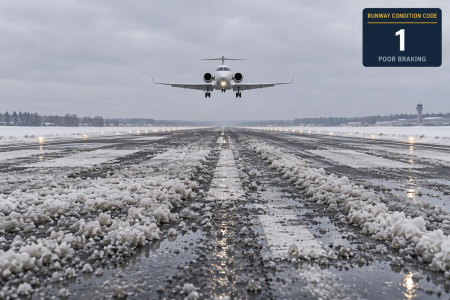
A runway condition codes report of 5/3/4 just came across the ATIS. The runway fits. The fuel is committed. But does that three-number sequence actually tell you whether you can stop? The RwyCC scale runs from 6 (dry) to 0 (nil braking)—a 7-point range where a single code difference can represent a substantial change in expected stopping performance—yet a code alone cannot tell a crew how many feet the aircraft needs to stop. That gap between the code and the decision is where accidents live.
Runway condition codes are standardized inputs, not landing-distance answers. A single code cannot account for aircraft type, weight, approach speed, tire condition, anti-skid behavior, reverse-thrust policy, or operator margins. The operational decision comes from combining the code with aircraft-specific approved performance data, wind, slope, runway geometry, temperature, contamination depth, and company margins.
The Global Reporting Format (GRF) became the internationally harmonized framework in November 2021, giving crews and operators a common language for contaminated runway landing distance assessment. That makes this a relatively recent operational shift—one many line pilots may not have fully internalized. If you still treat a RwyCC as a go/no-go answer by itself, this article is built to change that. What follows is a complete, practical workflow for turning a three-segment RwyCC into a defensible go/no-go number.
TALPA and the Global Reporting Format: How Standardized Runway Condition Assessment Began
The FAA’s TALPA framework—Takeoff and Landing Performance Assessment—established a standardized approach for evaluating runway contamination and communicating expected aircraft performance. It gave U.S. operators a structured way to connect what the airport observes on the surface with what the aircraft needs to stop. ICAO’s Global Reporting Format (GRF), implemented internationally in November 2021, became the broader foundation, using the Runway Condition Assessment Matrix (RCAM) to convert observed surface conditions into numerical RwyCC values.
The TALPA runway condition assessment matrix and the RCAM serve the same purpose: a common language. Before these frameworks, crews received inconsistent surface descriptions that varied by airport, country, and observer. Now, a numerical code backed by defined contaminant criteria travels with the report.
EASA and FAA systems are similar but not identical in presentation. FAA guidance references 1/8 inch as a relevant contamination-depth threshold, while EASA examples reference approximately 3 mm. International operators cannot assume identical implementation—verify the authority-specific material that governs your operation. The point is not regulatory trivia. The point is that crews now share a structured framework. How well they use it determines whether the framework saves lives or creates false confidence.
For the authoritative regulatory source, the FAA TALPA program page provides current guidance documents, advisory circulars, and operator resources directly from the governing authority.
Reading the Runway Condition Report: Three Thirds, Three Distinct Risks
Every runway is divided into three segments for condition reporting: touchdown zone, midpoint, and rollout/end. Each third receives its own RwyCC and contaminant description. The runway surface condition report should include the RwyCC for each third, contaminant type, contaminant depth, percentage of coverage, and relevant surface descriptors.
A runway may have mixed conditions—and that is where interpretation matters most. Consider a report of 5/3/4: the touchdown zone is coded 5 (wet), the midpoint is coded 3 (compacted snow), and the rollout end is coded 4. The crew must evaluate the whole landing path, not anchor on the highest or lowest number in isolation.
Which third carries a low code is operationally significant:
- A low code in the touchdown zone affects initial deceleration and directional control immediately after flare—before the aircraft has fully transitioned to ground roll.
- A degraded midpoint can become critical after touchdown, when the aircraft is decelerating through higher ground speeds and braking demands increase.
- A low code in the rollout/end third affects the final phase of stopping, where remaining runway is shortest and options are fewest.
The crew’s task is to assess all three runway thirds as a continuous stopping environment, not three separate problems. Build the mental picture of the entire landing path before committing.
The RCAM: How Contaminant Type, Depth, and Temperature Determine the Code
The TALPA runway condition assessment matrix (and its ICAO/EASA counterpart, the RCAM) is the regulatory lookup tool linking surface condition, contaminant type, depth, and temperature to RwyCC assignments. Here is the RwyCC scale 0 to 6 overview:
- 6 — Dry
- 5 — Damp, frost, or limited wet contamination
- 4 — Compacted snow (cold conditions), wet ice with sand or chemical treatment, or other moderate contamination
- 3 — Wet snow, dry snow, compacted snow (warmer temperatures), or wet conditions above depth thresholds
- 2 — Standing water or slush above approximately 3 mm, or ice
- 1 — Ice, wet ice, or water/slush on compacted snow
- 0 — Nil braking: wet ice, water over ice, or conditions producing no effective braking
A counterintuitive fact: a RwyCC of 6 does not guarantee a completely dry runway. Under applicable GRF procedures, contamination affecting no more than 25% of a runway third may still permit code 6. Crews who assume “6 means dry” may be operating with less margin than they believe.
Contaminant depth matters significantly. Standing water or slush above approximately 3 mm is associated with degraded contaminated runway performance and elevated hydroplaning risk. In EASA RCAM examples, compacted snow codes vary with temperature—with −15°C identified as an important threshold, where colder compacted snow generally receives a higher code than warmer compacted snow. Operators should verify the authority-specific RCAM that governs their operation, as this threshold is specific to EASA examples and should not be assumed universal.
Critically, codes are not interchangeable with braking action reports. “Good,” “medium,” “poor,” and “nil” describe observed aircraft braking performance. RwyCCs describe assessed runway surface conditions. Related—but not synonymous.
From Runway Condition Code to Required Landing Distance
This is the operational core. Converting runway condition codes into a real go/no-go number is a structured workflow, not a single calculation. Each step matters independently.
- Decode the report by runway third. Identify the touchdown-zone, midpoint, and rollout codes, contaminant type, depth, and coverage. A report of 5/3/4 with compacted snow midfield and a wet touchdown zone is three distinct data inputs, not one averaged condition.
- Use the aircraft manufacturer’s approved performance method. Depending on the aircraft, this may be an AFM/POH chart, electronic performance tool, dispatch system, or aircraft-specific contaminated-runway model. No universal multiplier replaces this step.
- Calculate the contaminated runway landing distance. The result must reflect aircraft weight, approach speed, wind, runway slope, temperature, elevation, braking configuration, reverser policy, and the reported runway condition. Do not treat this as “add a percentage.”
- Apply the operator’s required safety margin. Regulatory requirements and company policies may demand additional margin beyond the calculated stopping distance.
- Compare the result with usable landing distance. Account for displaced thresholds, runway closures, declared distances (landing distance available), and any operational restrictions.
- Assess directional control and crosswind separately. A runway can provide adequate stopping distance while presenting unacceptable crosswind, hydroplaning risk on a contaminated runway, or contamination asymmetry. Stopping is not the only problem.
- Use the most limiting credible condition. If reports are stale, changing rapidly, or inconsistent with pilot observations, conservative reassessment is appropriate. Do not optimize for the best-case scenario.
- Establish a hard go/no-go rule before approach. Landing distance must remain within the operator’s approved limit with the applicable margin, and no separate crosswind, braking-action, or aircraft-system limitation may be exceeded. Decide before you descend—not on short final.
The conceptual formula is straightforward:
Landing margin = usable landing distance − required contaminated-runway landing distance
The result must be positive after all required regulatory and company margins. A positive number alone does not eliminate other hazards. Directional control, crosswind, and rapidly deteriorating conditions can independently make the operation unacceptable. Digital performance tools and EFBs are making it easier to integrate RCR data with aircraft parameters—but the crew remains responsible for the decision.
CTS Part 135 and IS-BAO/Part 91 training programs include contaminated-runway performance modules designed to build exactly this workflow.
Braking Action Reports and Pilot Feedback: The Other Half of the Picture
The RwyCC is an airport-assessed prediction. Braking action reports are observed performance from an actual aircraft under actual conditions. Both matter—and they serve different roles.
Pilots report observed braking using standardized terminology: good, good-to-medium, medium, medium-to-poor, poor, nil. These reports provide real-world evidence of how the surface is performing and may support a downgrade of the assigned code—or confirm that conditions match the assessment. The difference between a braking action report and a runway condition code is fundamental: one is a surface assessment, the other is an aircraft-observed result.
The runway report does not replace the pilot’s assessment. Crews must consider current weather, visual evidence, aircraft handling on touchdown, wind conditions, and any new braking reports received while on approach. Reporting observed braking action accurately using approved terminology is not a formality—it is the data the next crew depends on.
The SKYbrary Runway Condition Report reference provides a well-structured overview of how braking action and condition codes interact in operational practice.
Winter Runway Operations: When Conditions Change Faster Than Reports
A stale runway condition report is one of the most dangerous inputs in winter runway operations. Snowfall rate, temperature oscillating near freezing, treatment chemicals, windrows along runway edges, and rapidly changing precipitation can make an otherwise valid report obsolete in minutes.
The crew’s responsibility is to recognize when conditions have likely changed since the report was issued. If the ATIS reports light snow and the report is 45 minutes old, that report may no longer represent the surface. Conservative reassessment is appropriate—not optimistic extrapolation.
Braking performance is only one part of the winter risk picture. Lateral control, contamination variability across the runway width, reduced visual range, crosswind on a slick surface, and changing weather can be equally important. The professional response to dynamic conditions is structured reassessment—not guesswork, not paralysis.
Common Errors in Runway Condition Code Interpretation
These misconceptions about runway condition codes persist in line operations and training environments. Each one can erode safety margins:
- “RwyCC 3 means add a fixed percentage to landing distance.” Incorrect. The code is an input to an aircraft-specific approved performance method, not a universal multiplier. Different aircraft types respond differently to the same surface condition.
- “A RwyCC is the same as a braking action report.” No. The RwyCC is an airport assessment of surface condition. Braking action reports are observed performance from an aircraft. They inform each other, but they are not interchangeable.
- “The highest code on the runway determines the landing.” Each third matters independently. The most operationally critical segment may carry the lowest code—and ignoring it invites a runway excursion.
- “Code 6 guarantees a completely dry runway.” Under applicable GRF procedures, RwyCC 6 may be assigned when contamination affects no more than 25% of a runway third. Dry is the expected condition—not the guaranteed one.
- “If the calculated distance fits, the landing is safe.” Stopping distance is necessary but not sufficient. Directional control, crosswind, hydroplaning, contamination asymmetry, and changing conditions can independently make the operation unacceptable.
- “The code applies uniformly to the entire runway.” RCRs are reported by runway thirds. A single code does not describe the entire surface. Assess all three segments.
Putting It All Together: A Scenario-Based Decision Exercise
An aircraft is approaching a runway with a report of 5/3/4. The touchdown zone is wet (RwyCC 5). The midpoint has compacted snow (RwyCC 3). The rollout end is coded 4. Crosswind is 15 knots.
The crew decodes each third. The critical segment is the midpoint: RwyCC 3 with compacted snow means significantly degraded braking during the phase of ground roll where the aircraft is still at relatively high speed. The wet touchdown zone (code 5) is manageable but requires awareness of directional control during the flare and initial deceleration. The rollout end at code 4 provides somewhat better conditions for the final stopping phase.
Next, the crew runs the approved performance tool. The contaminated runway landing distance, calculated for the aircraft’s weight, approach speed, temperature, elevation, and the limiting RwyCC of 3, must fit within usable landing distance after the operator’s required margin. The 15-knot crosswind adds a directional-control risk that exists independently of the stopping calculation. On a surface coded 3 with compacted snow, lateral control authority is reduced. The crew assesses whether the crosswind component exceeds the operator’s contaminated-runway crosswind limit.
The margin is positive. The crosswind is within limits. The report is 20 minutes old and conditions are stable. The crew commits—with a go/no-go decision that is documented, defensible, and grounded in data rather than intuition.
Build the Decision Skills That Matter
The central principle bears repeating: runway condition codes tell the crew what the runway is expected to do. Approved aircraft performance data determines what the aircraft needs. Operational judgment determines whether the landing should go ahead.
Memorizing code tables is not enough. Crews need scenario-based practice interpreting mixed reports, running performance workflows, challenging stale data, and recognizing when a numerically acceptable result is still operationally unacceptable. That skill is built through repetition in realistic winter runway operations scenarios—not through passive study.
CTS training programs—including Part 135 and IS-BAO/Part 91 courses—provide structured, scenario-based contaminated-runway decision training with branching go/no-go exercises built around the workflow described in this article. If you want to move beyond knowing the codes to making defensible runway condition codes decisions under pressure, that is the next step.
Frequently Asked Questions About Runway Condition Codes
What do runway condition codes mean for landing performance?
Runway condition codes describe the expected braking and directional-control effect of the runway surface, rated on a 7-point scale from 6 (dry) to 0 (nil braking). They are an input to aircraft-specific performance calculations—not a direct statement of required landing distance. The code must be combined with aircraft data, wind, weight, and operator margins to determine whether the aircraft can stop within the available runway.
How does a RwyCC translate into required landing distance?
A RwyCC is entered into the aircraft manufacturer’s approved performance method—AFM charts, electronic performance tools, or dispatch systems—along with aircraft weight, approach speed, wind, temperature, and runway geometry. The output is a contaminated runway landing distance that accounts for the reported surface condition. That figure is then compared against usable landing distance with required margins applied.
What is the difference between a runway condition code and a braking action report?
A runway condition code is an airport-assessed evaluation of the surface condition for each runway third. A braking action report is an observed description of actual braking performance experienced by a pilot, using standardized terms: good, good-to-medium, medium, medium-to-poor, poor, or nil. Both inform the decision, but they measure different things—prediction versus observation.
How does TALPA use the runway condition assessment matrix?
The TALPA runway condition assessment matrix links observed contaminant type, depth, coverage, and temperature to a numerical RwyCC for each runway third. Airport operators use this matrix to assign codes, which are then reported to flight crews and dispatchers. The crew uses the assigned code as an input to aircraft-specific performance data to calculate required landing distance.
When should a pilot reject a landing based on runway condition codes?
A pilot should reject the landing when the calculated contaminated-runway landing distance—including all required margins—exceeds the usable landing distance, or when any independent limitation such as crosswind, directional control, hydroplaning risk, or stale/contradictory reports makes the operation unacceptable. A positive stopping margin alone does not make the landing safe. CTS courses provide scenario-based practice for exactly this decision.