
FAA Part 5 SMS Compliance Training for Part 135 Operators: What You Need to Know
On April 26, 2024, the FAA published the final rule making Safety Management Systems mandatory for Part 135 operators — and the compliance clock has been running ever since. Part 135 certificate holders now have until May 28, 2027 to develop, implement, and document a full SMS before submitting their Declaration of Compliance. That declaration is not the starting line. It is the finish line. Understanding what FAA Part 5 SMS compliance training actually requires is one of the most urgent priorities for Part 135 operators right now. Training is the operational backbone that makes every SMS pillar function — and operators who treat it as an afterthought will not be ready when the FAA comes looking for evidence of a living, implemented system.
FAA Part 5 SMS Compliance Training: The Compliance Clock Is Already Running
The FAA’s final rule, published April 26, 2024, formally extended the SMS requirements of 14 CFR Part 5 to Part 135 on-demand and commuter operators. This is not a proposed rulemaking or an advisory circular. It is a binding regulation with a hard deadline: every affected certificate holder must submit a Declaration of Compliance by May 28, 2027.
That Declaration is not a planning document or a letter of intent. It is the FAA’s formal confirmation that the operator has already developed, implemented, and documented a functioning Safety Management System. NATA has emphasized this point clearly — the declaration comes after the SMS is built and operating, not before. Operators who read “2027” and assume they have time to spare are misunderstanding the scope of what must be completed before that date.
For new Part 135 applicants, the timeline is even tighter. Any operator filing a certification application on or after May 28, 2024 must include SMS as part of the certification process. For them, the FAA Part 5 SMS training requirements are already in effect.
Operators currently participating in the FAA SMS Voluntary Program are not exempt. The FAA’s Part 5 FAQ states that these organizations must still formally notify their Certificate Management Team and submit a Declaration of Compliance when they meet Part 5 requirements. Voluntary participation does not automatically satisfy the regulation. The compliance obligation stands regardless of prior SMS engagement, and a documented training program must be in place to support it.
What FAA Part 5 Actually Requires: The Four Pillars of SMS
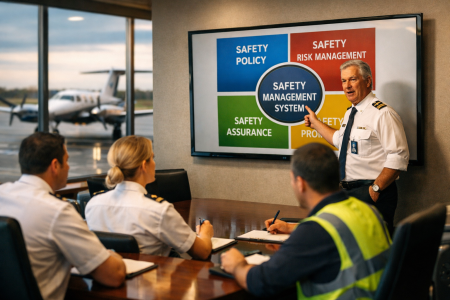
The FAA defines SMS as a “formal, top-down, organization-wide approach to managing safety risk and ensuring the effectiveness of safety risk controls.” That definition matters because it frames SMS not as a manual on a shelf, but as an active management system embedded in daily operations. The structure of that system is built on four pillars, each codified in 14 CFR Part 5 — and each demanding distinct training competencies from the people expected to operate it.
- Safety Policy (Subpart B). This pillar establishes the organization’s safety objectives, defines the accountable executive’s role, and sets expectations for employee reporting. Training competency required: every employee must understand the safety policy, know how to report hazards, and understand management’s commitment to a just culture. Accountable executive training is essential here — leadership must know what the regulation expects of them personally.
- Safety Risk Management (Subpart C). This pillar covers the systematic process for identifying hazards, analyzing risk, and implementing controls. Training competency required: personnel involved in safety risk management must be able to conduct hazard identification and reporting, perform risk assessment and mitigation, and document the rationale behind risk acceptance decisions.
- Safety Assurance (Subpart D). This pillar requires operators to monitor the effectiveness of risk controls, manage change, and continuously improve. Training competency required: safety managers and operational leaders must understand how to evaluate whether mitigations are working and how to initiate corrective action when they are not.
- Safety Promotion (Subpart E). This pillar mandates safety communication and training programs that support SMS competency across the workforce. Training competency required: the organization must deliver and document Part 5 SMS training that ensures all personnel can fulfill their safety responsibilities.
Each pillar requires distinct employee competencies. A pilot’s interaction with safety risk management is different from a dispatcher’s role in safety assurance, which is different from an accountable executive’s obligations under safety policy. This is precisely why a generic, one-size-fits-all course cannot satisfy the regulation. The FAA expects role-based competency, not uniform awareness.
Why One Generic Training Course Won’t Satisfy Part 5
One of the most persistent misconceptions in Part 135 operations is that a single awareness webinar or an off-the-shelf online course constitutes SMS training. It does not. The regulation requires an implemented, living management system — one in which employees at every level can perform their specific SMS functions, not just describe them.
Role-based training is a compliance necessity, not a best practice. Consider the range of SMS responsibilities across a typical Part 135 operation:
- Accountable executives must understand their personal regulatory accountability and their role in establishing safety policy and allocating resources.
- Safety managers must be able to facilitate hazard identification and reporting, lead risk assessments, and manage assurance activities.
- Pilots need to understand how to identify and report hazards within operational contexts and participate in risk controls.
- Dispatchers interact with safety assurance through monitoring and information flow — their training must reflect that function.
- Maintenance personnel must recognize hazards specific to their environment and understand how their reporting feeds the SMS.
Beyond role differentiation, aviation SMS compliance training must cultivate a just culture reporting environment. If employees fear punishment for reporting hazards or errors, underreporting will erode the data that feeds safety assurance — even when the documentation framework exists on paper. Just culture is not an HR aspiration. It is an operational requirement for the SMS to function.
The most important distinction operators should internalize: train people to operate an SMS, not just build one. Implementation training must go beyond theory and teach teams how to use the system’s tools — its reporting forms, risk matrices, escalation paths, and monitoring processes — in day-to-day work.
What Does FAA Part 5 SMS Compliance Training Need to Include?
A compliant Part 5 SMS training program must address competencies across all four pillars — Safety Policy, Safety Risk Management, Safety Assurance, and Safety Promotion — and must be differentiated by role. The following table summarizes minimum training competencies by personnel category:
- Accountable Executive: Safety policy obligations, regulatory accountability, resource allocation for SMS
- Safety Manager: Hazard identification and reporting, risk assessment and mitigation, assurance monitoring, corrective action
- Flight Crew: Hazard reporting procedures, risk controls relevant to flight operations, just culture principles
- Dispatchers: Safety assurance data flow, operational risk awareness, reporting responsibilities
- Maintenance Personnel: Maintenance-specific hazard identification, reporting workflows, how findings feed SMS
A documented training program must go beyond awareness — it must produce personnel who can actively operate the SMS tools and processes assigned to their role.
Building a Compliant SMS Training Program: Where to Start
For operators in the evaluation and planning phase, the path to implementing SMS compliance training under 14 CFR Part 5 follows a logical sequence. Each step builds on the previous one, and skipping ahead — particularly to delivery before design — undermines the compliance value of the entire program.
- Conduct an SMS gap analysis. Before designing any training, identify where your operation stands relative to Part 5 requirements. A gap analysis should evaluate your existing safety policy documentation, hazard reporting processes, risk assessment and mitigation procedures, assurance monitoring, and promotion activities. The gap analysis tells you what to train on — without it, you are guessing.
- Design role-specific training mapped to the four pillars. Using the gap analysis findings, build training modules that address the competencies each role requires under Safety Policy, Safety Risk Management, Safety Assurance, and Safety Promotion. This includes onboarding training for new hires, recurrent training for all personnel, supervisor and manager modules, and accountable executive awareness training. A Part 5 SMS training program must account for the distinct operational realities of Part 135 — smaller teams, dispersed bases, and variable schedules.
- Deliver training through scalable methods. For Part 135 operations with pilots, dispatchers, and maintenance technicians spread across multiple locations, e-learning is the most practical delivery method. It enables standardized content delivery while supporting role-specific modules. CTS also provides IS-BAO/Part 91 training for operators managing compliance across multiple operational frameworks.
- Track completion with LMS recordkeeping. Documentation is not an afterthought. It is what makes the Declaration of Compliance defensible when the FAA reviews your submission. An LMS should generate audit-ready records of who completed what training, when, and with what assessment results.
- Build recurrent training cycles. Part 5 compliance is not a one-time event. Safety Promotion requires ongoing training, communication, and competency reinforcement. Establish refresher cycles that keep SMS knowledge current and support continuous improvement — a core expectation of Safety Assurance.
The industry is shifting from SMS awareness to SMS operationalization. Operators who recognize this shift and build documented processes around recurring, role-based training will be positioned for audit readiness well before May 2027.
The Role of E-Learning in Scalable SMS Compliance
Part 135 workforces are often dispersed and on-demand by nature. Pilots may operate from multiple bases. Maintenance teams may rotate across locations. Classroom-only training is impractical for this operational model, and it creates documentation gaps that auditors will find.
LMS platforms enable operators to track completion, generate audit-ready records, and manage recurrent training schedules across every personnel category. Digital delivery supports standardized content while allowing role-specific modules — so the accountable executive receives different training than the line mechanic, but both completions are documented in the same system.
E-learning does not replace human judgment or operational leadership. But as a delivery and recordkeeping mechanism, it is the most scalable path to demonstrating the training component of a compliant SMS.
Common Misconceptions About SMS Training and Part 5 Compliance
“SMS is only for airlines.” This was true before April 2024. It is no longer true. The FAA’s final rule extends 14 CFR Part 5 to Part 135 on-demand and commuter operators. Every affected certificate holder faces the same Declaration of Compliance obligation, regardless of fleet size or operational tempo.
“You can wait until 2027 to start.” The May 28, 2027 deadline is for submitting the Declaration of Compliance — a document that certifies your SMS is already developed, implemented, and functioning. That deadline is the end of the process, not the beginning. Operators who have not started building their system are already behind schedule.
“A policy manual equals compliance.” Part 5 requires an implemented system with active processes, evidence, and monitoring. A binder of policies that no one uses does not satisfy the regulation. The FAA expects documented processes backed by training records, hazard reports, risk assessments, assurance data, and corrective actions.
“The Declaration of Compliance is the first step.” This may be the most dangerous misconception. NATA has stated plainly that the declaration comes after the SMS is developed and implemented. It is the final submission — the formal assertion that everything is in place. Treating it as a planning milestone will leave operators scrambling without a functioning system behind the paperwork.
Key Deadlines and Regulatory References for Part 135 SMS Compliance
- Primary regulation: 14 CFR Part 5 — Safety Management Systems
- Final rule published: April 26, 2024
- Declaration of Compliance deadline (Part 135): May 28, 2027
- New applicant requirement: Part 135 applicants filing on or after May 28, 2024 must include SMS in their certification
- FAA SMS Overview: https://www.faa.gov/faa-aviation-safety-outreach/safety-management-system
- FAA Part 5 FAQ: https://www.faa.gov/media/96306
- NATA SMS Page: https://nata.aero/safety-management-system-sms/
What Part 135 Operators Should Do Now
With approximately two years remaining before the May 28, 2027 deadline, the window for building a compliant SMS — and the FAA Part 5 SMS compliance training infrastructure to sustain it — is narrowing. The implementation and documentation work is substantial, and operators who have not started are already working against the clock.
The three most important next steps for any Part 135 certificate holder:
- Assess current SMS readiness through a structured gap analysis that identifies deficiencies in policy, reporting, risk management, assurance, and promotion.
- Build a role-based training program aligned with the four pillars of 14 CFR Part 5, with distinct modules for accountable executives, safety managers, flight crews, dispatchers, and maintenance personnel.
- Implement scalable delivery and recordkeeping through an e-learning platform that tracks completion, supports recurrent training cycles, and generates the documentation needed for audit readiness.
For Part 135 operators building or upgrading their SMS training programs, CTS offers training solutions developed specifically for the compliance requirements ahead. Explore CTS’s Part 135 training programs designed to support FAA Part 5 SMS compliance — visit the Part 135 Training page to learn more.