
Helicopter Ditching Procedures: Building the Muscle Memory That Saves Lives
Helicopter ditching procedures are the difference between survival and catastrophe — but only if they have been trained to the point of automaticity. Picture this: a twin-engine helicopter loses power 40 nautical miles offshore, at night, in moderate seas. The crew has roughly 60 seconds between the decision to ditch and water contact. In those 60 seconds, will your training take over — or will you have to think?
That question cuts to the core of helicopter water emergency procedures. Survival in a ditching event depends less on the quality of the touchdown and more on the quality of the preparation and egress that follows. Cabin preparation, flotation deployment, passenger briefing, and practiced underwater escape — these are the factors that determine who walks away. Yet too many operators treat ditching training as a checkbox exercise rather than a discipline that demands physical rehearsal and recurrent practice.
Here is the hard truth every pilot, crew member, and training manager needs to internalize: under the extreme stress of a water emergency, fine motor skills degrade, decision-making narrows, and only rehearsed automatic responses reliably execute. Ditching survival training for pilots and crew cannot stop at procedural knowledge. It must build muscle memory through repetition, realistic scenario practice, and recurrent helicopter underwater egress training. This article walks through the phases of a helicopter ditching, dismantles dangerous misconceptions, explains the science behind stress-induced performance failure, and provides a blended training framework that turns compliance into genuine preparedness.
What Happens During Helicopter Ditching Procedures: Phase-by-Phase Breakdown
A helicopter ditching — defined as a controlled, intentional landing on water — unfolds in distinct phases. Each phase demands specific crew actions, and failure at any phase cascades into the next. These phases happen fast and under extreme stress, which is precisely why helicopter ditching procedures must be rehearsed until they are automatic.
One critical caveat: procedures vary significantly by helicopter type, flotation system configuration, emergency exit placement, and operator SOPs. What follows is a generalized framework. Your aircraft-specific procedures and your operator’s standard operating procedures are the authoritative references for your operation.
Phase 1: Decision and Declaration
The ditching sequence begins with recognition that a water landing is unavoidable or represents the safest available option. The pilot-in-command declares a Mayday, communicates the ditching intention to ATC, and initiates crew notification. Helicopter ditching emergency decision-making is one of the first cognitive functions to degrade under acute stress, which makes rehearsed decision trees — practiced through scenario-based training — essential. Hesitation at this stage compresses every phase that follows.
Phase 2: Cabin and Crew Preparation
This is where survivability is largely determined — not at touchdown. The helicopter ditching checklist for crew during this phase includes: securing loose items that become projectiles on impact, confirming life jackets are donned but not inflated inside the cabin, briefing passengers on brace position and exit assignments, unlocking and identifying emergency exits, and confirming the flotation system is armed.
The quality of the passenger briefing directly affects survival outcomes. Passengers who know their exit assignment, understand the brace position, and have been told to inflate life jackets only after clearing the aircraft are dramatically better prepared than those receiving instructions for the first time during an emergency.
Phase 3: Impact and Flotation
Controlled water contact demands proper brace position execution from all occupants. Upon touchdown, helicopter emergency flotation systems deploy — inflatable bags or floats mounted on the airframe designed to keep the helicopter upright and afloat long enough for egress. These systems buy time, but flotation system performance depends on sea state, impact attitude, helicopter type, and system maintenance condition.
Even with flotation, dynamic inversion — the helicopter rolling inverted — remains a real possibility, especially in rough seas. Crews must be prepared for the scenario where the cabin is underwater and upside down within seconds of contact.
Phase 4: Egress and Post-Impact Survival
Post-impact evacuation is where disorientation, reduced visibility, cold shock, and panic converge. The sequence: maintain a reference point (hand on exit or known structural reference), wait for water motion to stabilize if possible, execute the exit, inflate the life jacket only after clearing the aircraft, move away from the helicopter, and activate survival equipment.
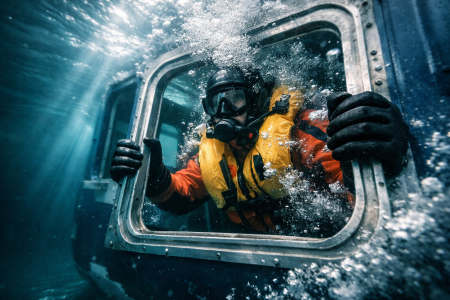
Helicopter underwater egress training targets this phase specifically because escaping from an inverted, submerged cabin is where untrained occupants most often fail. Spatial reasoning becomes unreliable. Visibility drops to near zero. Cold water triggers involuntary gasping. Muscle memory — built through repeated physical rehearsal — is the only reliable mechanism for executing egress under these conditions. Post-egress priorities shift to signaling, grouping with other survivors, and managing hypothermia exposure.
The Misconceptions That Kill: What Most Crews Get Wrong About Helicopter Water Emergencies
Dangerous assumptions persist across the industry. Each of the following misconceptions creates a false sense of security that can prove fatal.
Misconception: “Ditching is mostly about the landing.”
Reality: A well-executed touchdown means nothing if the cabin was not prepared, passengers were not briefed, and exits were not identified. Helicopter water emergency procedures place the survival burden on preparation and egress — not on the flare over water.
Misconception: “If the helicopter floats, everyone is safe.”
Reality: Helicopter emergency flotation systems buy time, but they do not guarantee safety. Inversion in rough seas, darkness, cabin confusion, and passenger panic can still be lethal. Flotation keeps the aircraft on the surface; trained egress gets people out of it.
Misconception: “A life jacket guarantees survival.”
Reality: A life jacket improves survival outcomes only if the wearer can exit the aircraft without entrapment. Inflating a life jacket inside the cabin can pin the wearer against the ceiling — or the floor, if the helicopter has inverted — making escape impossible. Inflate outside, never inside.
Misconception: “One briefing is enough.”
Reality: Retention of emergency procedures under stress is poor without recurrent training. A single annual briefing does not build the procedural memory needed to execute helicopter water landing procedures when adrenaline is overriding higher cognitive functions.
Misconception: “Ditching procedures are the same for all helicopters.”
Reality: Procedures vary significantly by helicopter type, flotation system design, emergency exit placement, overwater certification basis, and operator SOPs. Generic knowledge is a starting point, not a survival plan. Crews must train on their specific aircraft and their specific operator’s procedures.
Why Knowledge Alone Fails: The Science of Stress and Muscle Memory
Understanding helicopter ditching procedures intellectually is not the same as being able to execute them in the water. This distinction is not academic — it is the dividing line between survival and drowning.
Under acute stress, the body shifts to sympathetic nervous system dominance. Heart rate spikes. Fine motor skills degrade significantly. Complex decision-making compresses to tunnel-vision responses. This is the body’s survival mode, and it does not care about the procedure you read in a manual last month.
Now compound that stress response with the realities of a post-impact helicopter cabin: dynamic inversion has flipped the aircraft. The cabin is filling with water. Visibility is zero. Cold shock triggers involuntary inhalation reflexes. Spatial orientation — which way is up, where is the exit — becomes unreliable. Underwater disorientation, reduced visibility, and degraded fine motor skills combine to make untrained egress extremely difficult.
Only procedures that have been physically rehearsed to automaticity — true muscle memory, encoded in procedural memory pathways — reliably execute under these conditions. Reading a manual does not create those neural pathways. Watching a video does not create them. Completing a single briefing does not create them. Ditching survival training for pilots and crew members must include repeated physical practice, specifically helicopter underwater egress training in realistic conditions, to build the automatic responses that function when conscious thought is overwhelmed.
Single-event briefings are insufficient for genuine preparedness. This is not opinion — it is an established principle of emergency training science. If your organization’s ditching training program consists of an annual slide deck and a checkbox, your crews are compliant. They are not prepared. Those are different things.
Building a Blended Training Program That Actually Prepares Crews
Effective helicopter ditching procedures training requires a blended model built on three pillars. Each pillar is necessary but insufficient alone — the combination is what creates genuine readiness. Training content should also be tailored by operation type, whether offshore transport, EMS, VIP, or public service, because the operational context shapes the risk profile and the procedural details.
Pillar 1: Scenario-Based E-Learning for Theory and Decision Training
E-learning serves as the foundation layer, delivering standardized instruction on ditching decision triggers, aircraft-specific helicopter water emergency procedures, life jacket and flotation equipment use, brace positions, evacuation sequences, and role-specific crew actions. The most effective e-learning is scenario-based, using branching decision paths that force learners to apply knowledge under simulated pressure — not passive slide decks that test recall of definitions.
Scenarios should include loss of power over water, night helicopter ditching procedures, compromised flotation, and cabin inversion. E-learning allows standardized delivery across dispersed operations, trackable completion for compliance documentation, and efficient updating as regulations change. For helicopter ditching procedures for offshore pilots and other specialized operations, CTS’s scenario-based e-learning modules provide the kind of structured decision-training design that turns theory into practiced judgment.
Pillar 2: Hands-On Underwater Egress and Practical Drills
No amount of e-learning substitutes for the physical experience of operating underwater in a confined, disorienting space. Pool-based helicopter dunker exercises, simulated cabin inversion, and practice locating and operating exits while submerged and disoriented — this is where muscle memory is actually built. Helicopter underwater egress training converts knowledge into capability by forcing the body to perform the actions under conditions that approximate real-world stress.
This pillar is irreplaceable. It is also the phase where crews discover whether their theoretical understanding actually translates to physical execution. For many, the first dunker experience reveals a gap between what they know and what they can do — a gap that only repetition closes.
Pillar 3: Recurrent Refreshers to Maintain Retention
Skills degrade over time, especially skills used only in emergencies. Recurrent training — both e-learning refreshers and periodic practical drills — is essential to maintain the automatic response pathways built during initial training. Regulatory frameworks from both FAA and EASA establish recurrency requirements for emergency procedures, recognizing that initial qualification alone does not sustain readiness.
A strong recurrent program does not repeat initial training verbatim. It introduces new scenarios, incorporates regulatory updates, and adds progressive complexity. The goal is to stress-test existing muscle memory and expand the range of conditions under which automatic responses function reliably.
Regulatory Framework: FAA, EASA, and ICAO Requirements for Overwater Operations
Helicopter ditching procedures training exists within a regulatory ecosystem that operators must understand and track. Requirements are not static, and a training program that was compliant two years ago may not be compliant today.
FAA: The primary regulatory frameworks governing helicopter overwater operations, emergency equipment, and passenger briefings fall under 14 CFR Parts 91, 135, and 121. Requirements vary by operation type and aircraft category. Helicopter ditching procedures training requirements for Part 135 operators, for example, differ from those under Part 91. FAA advisory material provides additional guidance on survival equipment, crew proficiency, and helicopter water landing procedures. The FAA’s recent final rule increasing cockpit voice recorder recording time to 25 hours for affected future aircraft production signals a broader regulatory trend toward enhanced safety data requirements — a reminder that regulatory expectations continue to evolve.
EASA: European helicopter operations are governed by the Easy Access Rules for Air Operations (current at Revision 24, March 2026), which consolidate implementing rules, acceptable means of compliance, and guidance material. EASA’s AMC/GM material provides detailed guidance on emergency procedures, equipment carriage, and crew training requirements. Keeping training current with EASA’s revision cycle is essential for European operators. A structured e-learning platform simplifies this by enabling rapid content updates as regulations change.
ICAO: ICAO serves as the global baseline for civil aviation standards and recommended practices. Member states align domestic regulations to ICAO Annexes, creating a harmonized framework for overwater operations, survival equipment standards, and emergency training requirements. For operators working across multiple jurisdictions, ICAO’s standards provide the common reference point for understanding minimum expectations. Specific applicable Annex references should be verified against current ICAO documentation for your operation.
Frequently Asked Questions About Helicopter Ditching Procedures
What Are the Steps in Helicopter Ditching Procedures?
Helicopter ditching procedures follow four phases: (1) decision and Mayday declaration, (2) cabin and crew preparation including life jacket donning and exit identification, (3) controlled water impact and flotation system deployment, and (4) egress and post-impact survival actions. Exact procedures vary by aircraft type and operator SOPs. See the phase-by-phase breakdown above for details.
How Do You Survive a Helicopter Water Landing?
Surviving a helicopter water landing depends on preparation, practiced egress, and correct equipment use. Wear your life jacket but inflate it only after exiting the aircraft. Know your exit assignment before impact. Maintain a physical reference point during egress. Move away from the helicopter after escape and activate survival equipment. Survival depends on training, not luck.
Is Helicopter Underwater Egress Training Required by the FAA?
FAA requirements for emergency training vary by operation type. Practical helicopter underwater egress training is not universally mandated across all Part 91 operations, but it is widely recognized as a best practice and is required by many operators and contracting entities, particularly in offshore operations under Part 135. Operators should verify current requirements against applicable regulations and their specific operating certificates.
What Is the Difference Between a Helicopter Ditching and a Crash Landing on Water?
A ditching is a controlled, intentional water landing where the crew has time to prepare the cabin, brief passengers, arm flotation systems, and execute procedures. An uncontrolled water impact provides no preparation window. This distinction is why the preparation phase of helicopter ditching procedures is so critical to survival outcomes.
How Does a Helicopter Emergency Flotation System Work?
Helicopter emergency flotation systems typically consist of inflatable bags or floats mounted on the airframe. They deploy on command or automatically upon water contact, keeping the aircraft upright and afloat long enough for occupant egress. Performance depends on sea state, impact attitude, helicopter type, and system maintenance condition. Flotation systems buy time — they do not eliminate the need for rapid, practiced evacuation.
From Compliance to Capability: Making Helicopter Ditching Procedures Training Count
The thesis of this article is straightforward: muscle memory is the dividing line between compliance training and survival capability. Procedural knowledge of helicopter ditching procedures without physical rehearsal creates a dangerous illusion of preparedness — an illusion that will collapse the moment cold water fills the cabin and the world turns upside down.
Training managers and safety officers owe it to their crews and passengers to evaluate current programs honestly. Does your training build automaticity, or does it build familiarity? Does it include all three pillars — scenario-based e-learning, hands-on helicopter underwater egress training, and recurrent refreshers — or does it rely on one and hope the rest takes care of itself?
Every crew member and every passenger who flies over water deserves the best possible chance of surviving a ditching event. That chance is built in training, long before the emergency occurs. For operators building or upgrading their helicopter water landing procedures and emergency training programs, CTS’s Part 135 training programs provide the scenario-based e-learning layer that turns regulatory compliance into genuine operational capability — the first pillar of a blended program designed to save lives.