
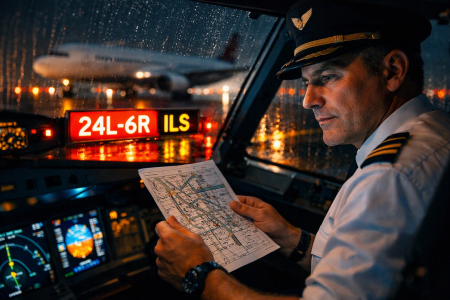
Runway Incursions Start Small: The Taxi, Clearance, and Hot Spot Errors Pilots Miss
More than 1,200 runway incursions occur in the United States every year — and pilot deviations account for roughly 60% of them, according to compiled industry data. But here’s the part most pilots overlook: almost none of those events started at the runway edge. They started minutes earlier, with a taxi clearance that wasn’t fully briefed, a readback that went uncorrected, or a hot spot that was glanced at but never truly seen.
Runway incursion prevention is not about rare anomalies. They are a persistent, systemic challenge to airport surface safety — one that touches every pilot who taxis an aircraft. The goal of this article is not to recite rules you already know. It is a practical diagnostic: a way to identify the specific small errors that accumulate during taxi and to sharpen the skills that break the error chain before it reaches the hold-short line. Runway incursion prevention is not about memorizing prohibitions. It is about building professional habits that intervene early, every time you move on a surface.
Why Runway Incursions Are a Chain-of-Events Problem, Not a Single Mistake
Runway incursions are rarely caused by a single factor. Research consistently confirms they arise from combined human, environmental, and procedural breakdowns rather than one isolated failure. One European analysis found that approximately 58% of incursion-contributing errors were attributed to pilots, roughly 22% to controllers, and about 20% to vehicle or pedestrian operators. The distribution tells an important story: this is a shared-accountability problem that spans the entire surface-operations environment.
The misconception that incursions happen because “someone broke a rule” misses the real pattern. What actually occurs is a gradual degradation of situational awareness and communication that accumulates across multiple decision points. A clearance is heard but not fully processed. A taxi route is accepted but not briefed against the airport diagram. A hot spot is on the chart but never verbalized. Each lapse, on its own, is recoverable. Stacked together, they deliver an aircraft onto an active runway.
Transport Canada’s 2025 aviation safety letter reinforces this model directly: the biggest cause leading to runway incursions is communication — and the assumption that communication occurred. That phrase deserves a second read. It is not just failed communication that creates risk. It is the belief that communication succeeded when it did not. Runway incursion prevention, then, is not about adding more rules. It is about building the discipline to verify at every intervention point in the chain. The rest of this article maps exactly where those intervention points are.
Taxi Clearance Errors: Where the Runway Incursion Chain Usually Begins
If you want to find the earliest and most common point where the error chain forms, look at the moment a taxi clearance is issued. This is where communication failures — the dominant causal theme in incursion events — most often take root. Two specific breakdowns recur: incomplete or inaccurate readbacks, and failure to brief the taxi route before releasing the brakes.
The Readback Is Not a Formality
FAA guidance emphasizes accurate readback and active listening for ATC corrections as a primary defense against taxi clearance errors that lead to runway incursions. Yet readback errors persist because pilots treat the exchange as a procedural formality rather than a critical cross-check.
Consider a realistic scenario. Ground control issues: “Cessna 4-7-Lima, taxi to Runway 28R via Alpha, hold short of Runway 10.” The pilot reads back: “Taxi to Runway 28L via Alpha, hold short of Runway 10, Cessna 4-7-Lima.” The difference between 28R and 28L is one letter — and if the controller is managing a busy frequency and does not catch the mismatch, the aircraft is now taxiing toward the wrong runway with both parties believing communication succeeded. ICAO and FAA standards exist precisely to prevent this: standardized phraseology, deliberate readback, and active listen-back by the controller. Your job is to make the readback accurate and complete every time, and to listen for a correction or lack thereof.
Brief Before You Move
Receiving a clearance is not the same as understanding it. Before releasing the brakes, brief the full taxi route on your airport diagram. Trace the route. Identify every runway crossing, every hold-short point, and every turn. If you have a moving map, use it alongside the chart — not instead of it. Airport diagram use and electronic position confirmation together create a layered defense against loss of positional awareness.
If the clearance is complex or unfamiliar, request a progressive taxi. If any part of the instruction is unclear, stop and clarify before moving. This is not a sign of weakness or confusion — it is a professional habit practiced by experienced crews worldwide. Normalize the “stop and ask” behavior in your operation, and you remove one of the most common links in the incursion chain.
Airport Hot Spots: More Than a Mark on the Chart
Airport hot spots are specific locations on an airport surface where runway incursion history, confusing geometry, or both make errors more likely. The FAA Runway Safety Program publishes hot spot data directly on airport diagrams, marking these areas with distinctive identifiers. They are not decorative. They are actionable intelligence — a documented signal that other pilots and vehicle operators have made errors at that exact location.
The misconception that airport hot spots are “just another marking on the chart” undermines their purpose. Each hot spot represents a pattern of prior events or a design feature that degrades positional awareness. A converging taxiway that visually resembles a runway. An intersection where two runways cross and signage is ambiguous. A turn that places you unexpectedly close to an active threshold.
The professional response to airport hot spots and runway incursion risk is straightforward:
- Before taxi: Identify which hot spots are on your route and brief them by name or number.
- Approaching a hot spot: Heads up, confirm your position on the diagram, verbalize your crossing or routing intentions to the other pilot or crew member.
- If uncertain: Stop. Verify. Request clarification from ATC.
In the chain-of-events model, recognizing a hot spot is an intervention point — a moment where heightened vigilance can interrupt a developing error before it reaches a runway edge. Treat hot spots as a risk-management cue, and they do exactly what they were designed to do.
Sterile Cockpit on the Ground: Why Taxi Demands the Same Discipline as Approach
Most pilots associate the sterile cockpit rule with flight operations below 10,000 feet. The regulatory anchor — 14 CFR 121.542 and 135.100 — applies to Part 121 and Part 135 operations during critical phases of flight. But the principle extends well beyond those certificates. Sterile cockpit during taxi and runway safety are directly linked: surface movement is a high-risk environment, and distraction is a repeatedly cited contributing factor in incursion events.
Think about what actually happens during taxi. Passenger briefings run late. FMS programming competes for attention. A crew member brings up a scheduling question. A checklist demands heads-down time at the worst moment. Each of these pulls attention away from the airport surface — away from signs, markings, and ATC instructions that require continuous monitoring.
The discipline is the same one you apply on approach: nonessential conversation stops, workload is managed to keep eyes and ears on the operational environment, and crew members actively cross-check position and clearance compliance. This behavior needs practice, not just policy. Train your crew on when to pause nonessential tasks and how to manage ground workload so that surface movement gets the attention it demands.
Low Visibility, Night Ops, and Complex Airports: When Small Errors Multiply Faster
Environmental and airport-design factors do not create runway incursions on their own — but they accelerate every weakness in the error chain. Complex airport layouts with intersecting runways, parallel taxiways, and active construction zones reduce the margin for error. Low visibility strips away the visual confirmation cues that pilots rely on to verify position. Night operations compress contrast and make signage harder to read at speed.
Under these conditions, pilots become more dependent on airport diagrams, lighting systems, and ATC instructions for situational awareness on the ground. Any gap in the earlier links of the chain — an incomplete readback, an unbriefed hot spot, a moment of distraction — becomes amplified because the environment offers fewer recovery cues. ICAO’s framework for aerodrome surface risk requires risk controls across degraded conditions precisely because the system has less redundancy when visibility drops or geometry confuses.
Advanced detection technologies — surface radar, ASDE-X, and runway status light systems — provide valuable supplemental protection. But research is clear: these technologies supplement, not replace, human cross-checks. Your own positional awareness, your discipline in verifying clearances, and your willingness to slow down and clarify remain the primary defense. The habits described in the preceding sections matter even more when conditions degrade.
A Practical Runway Incursion Prevention Checklist for Every Taxi
Everything above distills into a set of repeatable, trainable habits. This is not about heroics. It is about small, consistent behaviors that break the error chain before it reaches the runway. Preventing runway incursions as a pilot starts here:
- Brief the full taxi route on the airport diagram before releasing brakes. Trace every turn, runway crossing, and hold-short point. No movement until the route is understood.
- Identify hot spots on your route and verbalize them. Call them out to your crew or say them aloud if single-pilot. Know where the risk is concentrated.
- Read back every taxi and hold-short clearance completely — and listen for corrections. Partial readbacks are incomplete defenses. Include runway identifiers, hold-short instructions, and your callsign.
- Use your moving map and paper or digital chart together for position confirmation. One source confirms; two sources verify. Layered defense works.
- Maintain sterile cockpit from pushback or engine start through runway entry. Nonessential conversation, programming, and tasks wait until you are established on the runway or clear of the surface.
- If uncertain of position or clearance, stop and ask. Do not assume. Do not guess. A clarification call is a professional skill, not an admission of confusion.
- At night or in low visibility, increase verbal cross-checks and slow the taxi pace. Reduced cues demand increased discipline. Give yourself time to verify.
Bookmark this list. Review it before your next flight. These are the intervention points where the chain breaks — if you use them.
Building Runway Incursion Prevention Into Training Culture
Individual habits are essential, but they erode without organizational reinforcement. Runway incursion prevention training for pilots should be scenario-based, not rote memorization of phraseology and rules. The difference matters: rote training teaches what to say, while scenario-based training teaches what to do when the real world gets complicated.
Effective training programs incorporate several elements. E-learning modules should include airport hot spot exercises that require pilots to identify risk areas on real airport diagrams and make routing decisions under realistic constraints. Readback and listen-back drills should go beyond repetition — they should test whether students notice and correct mismatches between clearance and readback. Dedicated modules for low-visibility and night taxi scenarios prepare crews for the conditions that accelerate errors. The FAA Runway Safety Program provides hot spot data and educational tools that training departments can integrate directly into curriculum.
The SKYbrary Runway Incursion resource library — maintained in partnership with ICAO, EUROCONTROL, and FAA — offers additional reference material for training developers building scenario-based surface safety modules.
SMS integration connects the dots between individual pilot behavior and airport-level surface risk data. When a flight department links its hot spot awareness training to actual incursion reports and surface event data from its operating airports, crews begin to see runway incursion prevention not as an abstract compliance exercise but as part of a living safety management system.
Knowing what to do is the first step. Building it into your training program ensures it becomes repeatable, measurable, and part of your operation’s safety culture. CTS’s Part 135 and IS-BAO/Part 91 training programs offer structured, scenario-based curriculum designed to build exactly this kind of operational discipline — including surface safety, crew resource management, and the professional habits that keep the error chain from ever reaching the runway.
Runway incursions start small. They start with the first unverified clearance, the first unbriefed hot spot, the first moment of distraction during taxi. And that is precisely why they are preventable. Every taxi you fly is an opportunity to practice the discipline that breaks the chain — to brief, verify, cross-check, and clarify before the margins disappear. The pilots who make runway incursion prevention a habit, not an afterthought, are the ones who never have to explain how they ended up on an active runway. Before your next flight, pull up your departure airport’s diagram and review the hot spots on your route. That single act is where the chain stops.
Related CTS Training
Frequently Asked Questions: Runway Incursion Prevention
What causes most runway incursions?
Most runway incursions result from a chain of small errors rather than one catastrophic mistake. The primary causes include failed or assumed communication, incomplete taxi clearance readbacks, failure to brief airport hot spots, loss of positional awareness on the ground, and distraction during taxi. Pilot deviations account for approximately 60% of all U.S. runway incursions.
How can pilots prevent runway incursions during taxi?
Pilots can prevent runway incursions by briefing the full taxi route on an airport diagram before moving, reading back every clearance completely and listening for ATC corrections, identifying and verbalizing hot spots on their route, maintaining sterile cockpit discipline from pushback through runway entry, and stopping to request clarification whenever position or clearance is uncertain.
What are airport hot spots and why do they matter for runway safety?
Airport hot spots are specific locations on an airport surface — marked on FAA airport diagrams — where runway incursion history, confusing taxiway geometry, or poor signage make errors more likely. They represent documented patterns of prior incidents. Pilots should identify hot spots on their taxi route during preflight briefing, verbalize them before approaching, and slow down or stop to verify position when transiting them.
Why is readback discipline important for preventing runway incursions?
Readback errors are a leading contributor to runway incursions because they create the false assumption that both pilot and controller share the same understanding of a clearance. A single transposed runway identifier — such as 28R versus 28L — can direct an aircraft toward the wrong runway. Complete, accurate readbacks followed by listening for ATC corrections form a critical cross-check that interrupts the error chain before it reaches the runway.
What should a pilot do if unsure of a taxi clearance?
If unsure of any part of a taxi clearance, a pilot should stop the aircraft immediately, hold position, and contact ATC for clarification before proceeding. Requesting a progressive taxi is also appropriate when the route is complex or unfamiliar. Stopping to verify is a professional, trained behavior — not an admission of confusion — and is one of the most effective single actions a pilot can take to prevent a runway incursion.