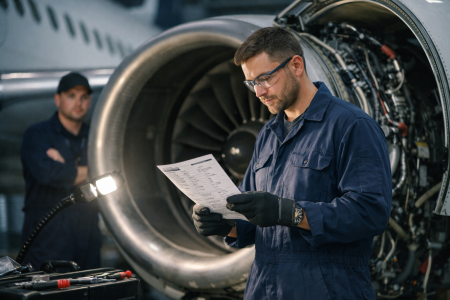
Aviation Maintenance Safety Training: Human Factors, Errors, and Prevention
Why Human Factors Drive 80% of Aviation Maintenance Errors
According to the FAA, approximately 80% of aviation maintenance safety training gaps trace directly to human factors—and MEDA investigations consistently show that 80–90% of the contributing causes are under management control, not the fault of individual technicians. These numbers reveal exactly why traditional aviation maintenance safety training approaches fall short. Effective aviation maintenance safety training must move beyond compliance checklists and individual blame to address systemic aviation maintenance human factors through proven frameworks like the Dirty Dozen, MEDA, and SCTA.
This is not a technician competence problem. It is a systemic design and management problem. When the same errors recur across different technicians, different shifts, and different facilities, retraining individuals addresses the symptom while ignoring the root cause. Consider the documented cases of inadvertent emergency slide deployments on Airbus A320 aircraft—retraining alone failed to prevent recurrence because the error was embedded in the task design and environmental conditions, not in any single technician’s skill deficit.
The industry has accumulated decades of evidence: maintenance safety compliance training built on rote memorization and annual checkbox exercises does not change behavior on the hangar floor. What changes behavior is genuine human factors competency—understanding why errors occur, how systemic precursors create error-prone conditions, and what proactive interventions actually work. The sections that follow lay out the frameworks, regulatory requirements, and training design principles that make this shift possible.
The Dirty Dozen: 12 Human Factors Every Aviation Technician Must Know
The Dirty Dozen framework identifies 12 key human factors recognized as common precursors to maintenance errors. Developed as a practical awareness tool for dirty dozen human factors aviation maintenance training, the framework helps technicians and supervisors recognize conditions that degrade performance before an error occurs. Every aviation technician safety training program should ground participants in these 12 factors:
- Lack of Communication — Incomplete shift turnovers or unclear work card instructions leave critical information gaps between teams.
- Distraction — Interruptions during maintenance tasks cause technicians to skip steps or lose their place in a procedure.
- Lack of Resources — Missing tools, parts, or documentation force workarounds that introduce error.
- Stress — Acute or chronic stress narrows attention and degrades decision-making under time constraints.
- Complacency — Routine familiarity with a task reduces vigilance, especially on high-frequency inspections.
- Lack of Teamwork — Poor coordination between shifts, trades, or departments creates gaps in task completion and cross-check coverage.
- Pressure — Schedule demands and aircraft-on-ground (AOG) urgency push technicians to shortcut procedures.
- Lack of Awareness — Tunnel vision on an immediate task prevents recognition of broader safety implications or adjacent hazards.
- Lack of Knowledge — Insufficient training on new aircraft types, systems, or amended procedures leaves technicians underprepared.
- Fatigue — Extended shifts, circadian disruption, and inadequate rest directly impair motor skill, judgment, and attention.
- Lack of Assertiveness — Junior technicians or inspectors hesitate to challenge a senior colleague’s decision, even when they spot an error.
- Norms — Unofficial shop practices (“the way we’ve always done it”) override published procedures and create unmanaged risk.
Fatigue, stress, and complacency are linked to the majority of MRO incidents. These three factors interact—a fatigued technician under schedule pressure becomes complacent on a task performed hundreds of times before. Effective aviation technician safety training programs use scenario-based exercises that replicate these compounding conditions rather than presenting each factor in isolation.
Beyond the Dirty Dozen: ICAO’s Expanded Precursor Framework
While the Dirty Dozen provides a practical starting point, ICAO Circular 240-AN/144 identifies over 300 human error precursors—expanding the taxonomy well beyond 12 factors to include environmental, organizational, and task-design precursors. Treating the Dirty Dozen as an exhaustive list leads to incomplete risk mitigation. Effective aviation maintenance safety training programs must address this broader landscape: lighting conditions, workspace ergonomics, documentation quality, scheduling patterns, and organizational communication structures all contribute to error-prone environments.
ICAO Annex 19 reinforces this expanded view by establishing the international standard for systematic error investigation within an aviation safety management system (SMS). Training programs that align with Annex 19 treat each maintenance event as a data source for identifying systemic precursors—not as evidence of individual failure.
MEDA: Investigating Aviation Maintenance Errors Without Blame
The Maintenance Error Decision Aid (MEDA) is a structured investigation framework that transforms how organizations analyze maintenance events. MEDA maintenance error decision aid training rests on three core assumptions: technicians do not make errors intentionally; errors result from multifactorial causes, not single-point failures; and 80–90% of contributing factors are under management control. These assumptions redirect investigation focus from punishing individuals to identifying systemic vulnerabilities in processes, procedures, facilities, and communication.
This shift is foundational to building a just culture in aviation maintenance. When technicians fear punitive consequences, near-miss reporting drops. When near-miss reporting drops, organizations lose the safety data they need to identify precursors before an incident occurs. MEDA-trained organizations break this cycle by establishing psychological safety as an operational requirement, not a cultural luxury.
ICAO Annex 19 supports systematic human error investigation through tools like MEDA, positioning it within the broader SMS framework. Organizations that implement FAA maintenance safety training aligned with MEDA principles gain actionable data—data that drives concrete prevention strategies such as staggered scheduling to mitigate fatigue, independent cross-checks at error-prone task completion points, and redesigned work card formatting to reduce communication gaps.
MEDA does not excuse errors. It explains them—and explanation is the prerequisite for prevention.
From Reactive to Proactive: SCTA and Error-Proof Design in Aviation Maintenance Safety Training
While MEDA investigates errors after they occur, Systematic Critical Task Analysis (SCTA) works upstream to identify error-prone tasks before incidents happen. SCTA applies structured analysis to maintenance procedures, identifying where task design, environmental conditions, or tooling create conditions that exceed normal human reliability thresholds.
An April 2026 case study on helicopter maintenance demonstrated SCTA’s practical value. Analysts applied the methodology to cable routing tasks—a procedure where training alone had proven insufficient. The analysis recommended hierarchy-of-controls solutions that reduced reliance on individual judgment:
- Engineering controls: Dedicated pulley grooves that physically prevent incorrect cable routing
- Environmental improvements: Enhanced task lighting at cable routing work stations
- Procedural redesign: Simplified work card sequencing with visual confirmation steps
- Administrative controls: Mandatory independent cross-checks at critical completion points
This approach reflects the broader industry trend toward error-proof aircraft maintenance design—engineering errors out of the task rather than relying solely on procedural compliance. The FAA Human Factors in Aviation Maintenance and Inspection research program, established under the Aviation Safety Research Act (P.L. 100-591, 1988), supports this research direction by funding studies on how aviation maintenance human factors interact with task design, workspace layout, and tooling.
Regulatory Foundations: FAA and ICAO Requirements for Aviation Maintenance Safety Training
The regulatory framework for FAA maintenance safety training and human factors integration has matured significantly over the past three decades. The Aviation Safety Research Act (P.L. 100-591, 1988) formalized the FAA’s Human Factors in Aviation Maintenance and Inspection research program, directing dedicated study into how human error contributes to maintenance-related accidents and how interventions can reduce that contribution. This legislation marked a turning point: the federal government acknowledged that airworthiness depends on human performance, not just technical standards.
The FAA Aviation Safety (AVS) Human Factors Program continues this mandate, embedding human factors specialists across the FAA organization to minimize error occurrence and impact in aviation systems. Their work informs advisory circulars, training guidance, and the development of FAA-compliant aviation maintenance safety training standards that operators and MRO facilities must address.
Internationally, ICAO Annex 19 establishes the framework for SMS-integrated human factors investigation, requiring member states to implement safety management systems that include systematic error analysis. ICAO Circular 240-AN/144 provides the expanded precursor taxonomy that informs global maintenance safety compliance training standards, covering environmental, organizational, and task-design factors far beyond the Dirty Dozen.
A critical clarification: regulations ensure qualifications through licensing and certification. They do not guarantee mistake-proof performance. Licensing confirms that a technician has demonstrated required knowledge and skill at a point in time. Ongoing human factors training and error-proof design are essential complements—without them, the approximately 80% human-error rate persists regardless of regulatory compliance.
What Effective Aviation Maintenance Safety Training Looks Like
Compliance-driven training checks boxes. It does not change behavior. Effective aviation maintenance safety training engages technicians in systemic thinking and equips them with tools to recognize, report, and mitigate error-prone conditions. An aviation MRO human factors training course built on current evidence includes these core elements:
- Dirty Dozen awareness modules with scenario-based simulations — Technicians work through realistic task scenarios (cable tensioning, borescope inspections, shift turnovers) where multiple Dirty Dozen factors interact, rather than studying each factor as an isolated concept. Scenario-based simulations outperform rote checklist training in knowledge retention and behavior change.
- MEDA investigation training for supervisors and technicians — Both groups learn structured investigation methodology. Supervisors gain skills for conducting non-punitive interviews and identifying management-controlled contributing factors. Technicians understand what information matters and why honest reporting protects the operation.
- SCTA integration for proactive error identification — Maintenance planners and lead technicians learn to apply critical task analysis to identify procedures where error risk exceeds acceptable thresholds, then recommend hierarchy-of-controls interventions.
- Fatigue management and staggered scheduling modules — With fatigue management in aviation identified as a top priority, training covers circadian science, fatigue risk indicators, and organizational scheduling strategies that reduce fatigue-related error exposure.
- Team communication and assertiveness training — Structured exercises build the skill of challenging unsafe conditions or decisions regardless of rank—a direct mitigation for lack of assertiveness and lack of communication in the Dirty Dozen.
- Just culture and psychological safety training — Organizations that foster psychological safety in aviation maintenance see higher near-miss reporting rates. Training modules define what just culture means operationally—distinguishing between honest error, at-risk behavior, and reckless conduct—and establish reporting as a professional obligation.
- Ongoing refresher training beyond initial compliance — Human factors awareness degrades without reinforcement. Effective programs deliver quarterly micro-modules and annual deep-dive sessions, not one-time onboarding events.
Because MEDA analysis shows 80–90% of contributing factors are management-controlled, aviation maintenance safety training must address organizational culture and systemic design—not just individual technician behavior. Online aviation maintenance safety training for technicians that integrates these elements gives organizations a scalable path to genuine risk reduction. Learn more about structured maintenance human factors training modules that address these requirements.
Technology Integration: Digital Tools That Reduce Human Error in Aircraft Maintenance
Digital tools map directly onto Dirty Dozen mitigation strategies. Digital checklists reduce distraction and lack of awareness by enforcing step-by-step task completion and flagging skipped items. Maintenance tracking software supports communication and resource management by providing real-time visibility into task status, parts availability, and shift turnover notes.
Emerging VR training tools allow technicians to practice error-prone procedures—such as confined-space inspections or complex wire routing—in a safe environment where mistakes become learning opportunities rather than safety events. These tools complement but do not replace human factors awareness training. Technology mitigates specific Dirty Dozen factors; understanding why those factors create risk requires structured instruction in human reliability science.
Frequently Asked Questions About Aviation Maintenance Safety Training
What are the human factors in aviation maintenance safety?
Human factors in aviation maintenance safety are the physical, psychological, organizational, and environmental conditions that influence technician performance and error likelihood. According to FAA data, approximately 80% of maintenance errors involve human factors. The Dirty Dozen framework identifies 12 common precursors, while ICAO Circular 240-AN/144 catalogs over 300 potential human error precursors spanning task design, workplace environment, and organizational culture.
How does the Dirty Dozen apply to aviation maintenance training?
The Dirty Dozen human factors framework provides a structured awareness tool used in training to help technicians recognize error-prone conditions—fatigue, distraction, complacency, pressure, and eight other precursors—in their daily work. It serves as a practical starting point for human factors education, though effective programs treat it as a foundation rather than an exhaustive list, supplementing it with ICAO’s expanded precursor taxonomy.
What are the FAA requirements for aviation maintenance safety training?
FAA requirements for aviation maintenance safety training stem from the Aviation Safety Research Act (P.L. 100-591, 1988) and the FAA Aviation Safety (AVS) Human Factors Program. These mandate that operators and MRO facilities address human performance in maintenance operations. Advisory circulars provide guidance on integrating human factors into training programs, while ICAO Annex 19 establishes the international SMS framework that underpins compliant programs globally.
What is MEDA and how is it used in aviation maintenance safety?
MEDA (Maintenance Error Decision Aid) is a structured investigation framework built on three assumptions: technicians do not make errors intentionally, errors are multifactorial, and 80–90% of contributing factors are under management control. Organizations use MEDA to shift investigation culture from individual blame to systemic prevention, generating actionable data that drives interventions like improved procedures, scheduling changes, and engineering controls.
How can aviation maintenance errors be prevented through training?
Prevention requires combining human factors awareness training, MEDA investigation skills, scenario-based simulation, fatigue management in aviation, technology tools (digital checklists, VR), and just culture development. Because 80–90% of error contributing factors are management-controlled, training must address organizational systems—not just individual performance. CTS offers courses designed around these principles for maintenance teams seeking systemic error prevention.
Building a Culture of Safety: Aviation Maintenance Safety Training Beyond Compliance
Aviation maintenance safety training that stops at compliance will continue to produce the same approximately 80% human-error rate. Compliance sets the floor. It was never intended to be the ceiling. The evidence is unambiguous: systemic error prevention requires training programs that build human factors competency, psychological safety, and error-proof design thinking into daily maintenance operations.
The industry’s direction is clear—toward proactive, technology-integrated, human-centered training that treats every error as a system signal rather than an individual failure. Organizations that adopt MEDA methodology, SCTA analysis, and scenario-based learning position themselves ahead of this curve. Those that do not will continue managing the same recurring events with the same ineffective tools.
For organizations ready to move from compliance-only training to programs built on human factors science and systemic error prevention, purpose-built e-learning platforms offer a practical starting point. Explore CTS’s aviation maintenance safety training programs to bring human factors awareness, MEDA methodology, and scenario-based learning to your maintenance team.