Night Vision Goggle Online Training for Pilots: Night Operations, Human Factors, and Safety Risks
Generation 3 night vision goggles can amplify starlight into a usable image through advanced photocathode and micro-channel plate technology — yet they fail completely in total darkness, degrade depth perception, reduce peripheral vision, and accelerate eye fatigue. For helicopter EMS, law enforcement, and search-and-rescue pilots flying mission-critical operations at night, the device on their face can become the source of risk if they don’t understand its limitations. This is why structured night vision goggle online training for pilots — not just time wearing the goggles — is what separates safe operations from preventable accidents.
Why NVG Proficiency Starts With Ground Training — Not in the Cockpit
The goggles don’t keep pilots safe. Training does. NVGs amplify ambient light — moonlight, starlight, cultural lighting — via image intensifier tubes, photocathode technology, and phosphor screens to produce a green-hued image that makes night operations possible. But that capability comes with significant human factors challenges that standard night flying training does not address. NVGs are not plug-and-play devices.
Generation 3 NVGs represent the state-of-the-art for civil aviation. They use advanced photocathodes paired with micro-channel plates for high light amplification. Yet even Gen 3 technology fails in complete darkness, limits depth perception, restricts peripheral vision, and causes progressive eye fatigue over extended operations. These are not minor inconveniences — they are hazard vectors that demand dedicated academic instruction.
NVG pilot training must begin with ground school that covers optics, human physiology, visual illusions, and FAA regulations before a pilot ever enters a simulator or cockpit. Night operations online training for NVG-equipped pilots provides that essential academic foundation in a format that is repeatable, standardized, and accessible. For helicopter EMS crews, law enforcement aviation units, Part 135 operators, and training managers seeking scalable, FAA-aligned solutions, structured online ground training is the most cost-effective path to proficiency — and the most responsible one.
How Night Vision Goggles Work — And Where They Fall Short
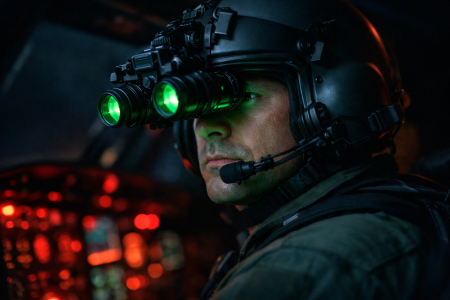
Understanding NVG technology starts with the image intensification chain. Ambient photons enter the objective lens and strike a photocathode, which converts light energy into electrons. In Gen 3 NVGs, those electrons pass through a micro-channel plate — a wafer containing millions of tiny glass channels — that multiplies the electron signal thousands of times. The amplified electrons then strike a phosphor screen, producing the characteristic green-hued image pilots see through the eyepiece.
That green image is useful, but it is not reality. The monochromatic display alters terrain cues and requires entirely new scanning techniques. Depth perception degrades because binocular cues are compressed through the narrow field of view — typically around 40 degrees compared to roughly 180 degrees of normal human vision. This is where night vision goggle aviation training becomes non-negotiable: pilots must learn to interpret a fundamentally different visual environment.
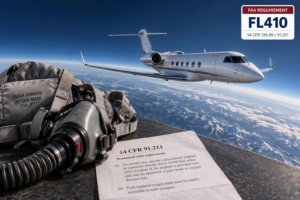
The limitations are real. Generation 3 NVGs produce no image without some ambient light source — overcast, moonless nights in remote terrain can render them ineffective. Depth perception loss at night through NVGs is a documented hazard, particularly during approach and landing phases. And a regulatory detail many pilots overlook: 14 CFR 91.205(h) specifies aircraft equipment and lighting requirements compatible with NVG operations. Incompatible cockpit lighting — glare from unfiltered displays, instrument backlighting, or caution panels — can silently degrade NVG performance without the pilot recognizing the cause.
Pre-Flight NVG Checks Pilots Cannot Skip
Every NVG operation begins on the ground. The following pre-flight checks are essential and non-negotiable:
- Objective focus adjustment — confirm sharp imagery at operational distances
- Diopter settings — calibrate to the individual pilot’s vision correction needs
- Battery levels — verify sufficient charge for the planned mission duration plus reserves
- Cockpit lighting compatibility verification — confirm all interior lighting is NVG-compatible and filtered to prevent glare
Skipping any of these checks silently degrades operational safety. Online ground training systematically teaches these procedures so they become habit before a pilot straps on goggles in a live environment.
Human Factors: The Real Safety Risk in NVG Operations
Hardware failure is not the primary threat in NVG operations. Human factors are. The greatest risks stem from how the human visual system, cognitive processing, and physiological state interact with the artificial image NVGs produce. As industry training experts emphasize, NVGs are “only as effective as the training behind them.” This is not a slogan — it is an operational truth validated by decades of night operations experience.
Standard night flying instruction covers basic night operations human factors like spatial disorientation and runway illusions. It does not cover the NVG-specific challenges of interpreting a monochromatic, field-of-view-restricted, phosphor-generated image while managing fatigue, cognitive load, and situational awareness demands simultaneously. An NVG pilot training course with human factors content addresses these gaps directly — and online ground school is the ideal delivery method because it allows systematic, repeatable instruction on physiological and cognitive challenges before flight exposure.
Visual Illusions and Depth Perception Loss
The green phosphor image alters how pilots perceive terrain, obstacles, and distance. Visual illusions in night flight are compounded through NVGs: flat terrain may appear to have contour, sloping ground can look level, and wires or towers may disappear against cluttered backgrounds. Depth perception loss at night is acute because the narrow field of view compresses binocular depth cues that pilots rely on instinctively during daytime flight.
Pilots accustomed to unaided night flight must learn the NVG scan technique — a disciplined pattern of head movement that compensates for restricted peripheral vision. Disciplined scanning and reliable visual cues through tinted goggles are essential, per expert guidance. These are trainable skills best introduced in ground school and rehearsed cognitively before attempting in-flight application. Pilots must “train like your life depends on it” — because it does.
Fatigue, Circadian Disruption, and Cognitive Load
NVG operations compound fatigue risks in ways that standard crew rest calculations do not capture. EMS and law enforcement pilots working irregular shifts already face circadian rhythm disruption that degrades cognitive performance, reaction time, and decision-making. Add the cognitive load of interpreting NVG imagery — constantly cross-referencing the green-hued scene against instruments, maintaining spatial orientation through a 40-degree window, and managing equipment throughout the mission — and the compounding risk profile becomes clear.
NVGs accelerate eye fatigue, further degrading performance during extended night operations. Pre-flight rod cell adaptation — protecting night vision before goggle use through controlled light exposure — is a critical step that many pilots neglect. This intersection of circadian disruption and NVG performance degradation is underserved in most training materials. Structured online ground training addresses it directly, building awareness before pilots face these risks in the operational environment.
FAA NVG Training Requirements: What Operators Must Know
The regulatory framework for NVG operations in civil aviation rests on several pillars. FAA Part 135 operations mandate specific NVG currency and proficiency standards for pilots, including evaluation by dedicated NVG instructors — not just any check airman. Training programs typically require several hours of classroom instruction plus dual night flights for proficiency, creating a significant time and resource commitment.
14 CFR 91.205(h) establishes the aircraft equipment baseline, specifying lighting requirements compatible with NVG operations to minimize glare and ensure safe use. FAA Advisory Circular AC 90-106A provides the primary guidance for night vision goggle operations and training standards in civil aviation, covering operations, training best practices, and recommended procedures. Note that as an advisory circular, AC 90-106A is guidance, not a regulatory mandate — but training managers should treat it as the foundational reference for program development and FAA alignment.
What Are the FAA Requirements for Night Vision Goggle Training?
FAA night vision goggle training requirements for Part 135 operators are defined primarily through 14 CFR Part 135 currency standards and FAA Advisory Circular AC 90-106A. Pilots must complete NVG ground school, simulator training where available, and dual in-flight hours with a qualified NVG instructor. Currency must be maintained through recurrent training evaluated by an NVG-qualified check airman. Equipment must meet 14 CFR 91.205(h) lighting compatibility standards. AC 90-106A provides detailed recommended training content, procedures, and operator guidance — and while advisory, it defines the industry standard for FAA-aligned NVG programs.
Can NVG training be completed online for Part 135 currency? The honest answer: online ground training satisfies the academic and ground school component and supports recurrent currency maintenance, but simulator and in-flight hours remain necessary for full proficiency checks. This is not a limitation of online training — it is the nature of psychomotor skill validation. The value of online NVG ground school is that it delivers the knowledge foundation reliably and at scale, freeing instructor time and flight hours for the hands-on proficiency work that requires them. CTS offers FAR Part 135 training packages that include NVG ground school modules designed for fleet-wide recurrent compliance.
Maintaining NVG Currency Across a Fleet
For Part 135 operators managing NVG currency across multiple pilots stationed at different bases, the logistics are daunting. Online NVG recurrent training for Part 135 pilots enables standardized, trackable ground school completion across geographically dispersed crews. Every pilot receives the same curriculum, assessed to the same standard, without travel costs or scheduling disruption. NVG recurrent currency training online for helicopter pilots transforms a logistical burden into a manageable, repeatable process — one that chief pilots and training managers can verify and document for compliance audits.
What Night Vision Goggle Online Training Covers: Course Structure and Content
A comprehensive night vision goggle online training program covers the full academic spectrum that pilots need before progressing to simulator and flight phases. Helicopter NVG online ground school training typically includes the following core modules:
- NVG System Components and Technology — Gen 3 optics, image intensifier tubes, photocathode-to-phosphor image chain, and performance specifications
- Human Factors — Visual illusions, depth perception loss, fatigue management, circadian rhythm effects, and rod cell adaptation protocols
- NVG Scanning Techniques and Terrain Recognition — The NVG scan, compensating for restricted field of view, interpreting monochromatic terrain cues
- FAA Regulations and SOPs — Part 135 NVG currency requirements, 14 CFR 91.205(h) equipment standards, AC 90-106A guidance
- Pre-Flight Equipment Checks — Objective focus, diopter settings, battery verification, and cockpit lighting compatibility protocols
- Cockpit Lighting Management — Identifying and mitigating glare sources, NVG-compatible lighting configurations
- Mission-Specific Applications — Air medical helicopter operations, law enforcement, and search-and-rescue scenarios
Helicopter NVG training programs follow a hybrid model: online ground school provides the academic foundation, followed by simulator training — now featuring 52+ real-world scenarios in virtual NVG simulators for zero-risk practice — and in-flight training with qualified NVG instructors. The online component is the essential first step, not a shortcut. See the full NVG training course outline and curriculum at CTS.
Advances in NVG Simulation Technology
Recent research highlights significant advances in NVG training simulation fidelity. High-fidelity NIR-LED direct-view display systems using 940 nm wavelengths can now replicate authentic nighttime scenes with high contrast and low power consumption. These systems address a longstanding limitation of conventional simulator displays, which often fail to produce imagery that NVGs can interpret realistically.
The NIR-LED technology enables dual-user training capability, allowing NVG-equipped and unaided pilots to train simultaneously in the same simulated environment. Inverse gamma transformation compensates for the nonlinear response characteristics of NVGs, ensuring that what the pilot sees through the goggles in the simulator closely matches real-world NVG imagery. These systems support all-weather simulation for full-flight and urban low-altitude operations — precisely the environments where NVG pilot training is most critical.
For operators evaluating whether online and simulator-based night vision goggle aviation training can adequately prepare pilots, the trajectory is clear: simulation fidelity is approaching real-world night operations with increasing accuracy. The gap between simulated and actual NVG environments continues to narrow, making the hybrid training model increasingly effective.
Common Misconceptions About NVG Operations
Misconception: NVGs are plug-and-play devices requiring minimal training.
Reality: NVGs demand specialized training far beyond standard night flying proficiency. Depth perception loss, visual illusions, glare from incompatible lighting, and accelerated fatigue are all hazards that require dedicated academic instruction and operational discipline to manage. NVG pilot training is not optional — it is a safety requirement.
Misconception: NVGs work in total darkness.
Reality: NVGs amplify ambient light. No ambient light means no image. On an overcast, moonless night in remote terrain, Gen 3 NVGs can produce an image so degraded it is operationally useless. Pilots must learn to assess ambient light conditions as part of mission planning.
Misconception: Military NVG experience transfers directly to civil operations.
Reality: Civil aviation NVG operations carry distinct regulatory and procedural requirements. FAA Part 135 currency standards, 14 CFR 91.205(h) equipment compliance, and AC 90-106A guidance create an operational framework that differs from military assumptions. Tinted views alter terrain cues, requiring new scanning techniques specific to civil mission profiles. Prior military NVG time is valuable, but it does not substitute for aviation-specific training aligned with FAA requirements.
Investing in NVG Training That Protects Your Crew and Your Operations
NVG safety is a training problem, not a technology problem. The goggles will perform to their specifications. The question is whether the pilot behind them has the human factors knowledge, regulatory awareness, and operational discipline to use them safely. Structured night vision goggle online training is the most scalable, cost-effective way to build that foundation — ensuring every pilot in your operation understands visual illusions, depth perception degradation, fatigue management, and FAA NVG training requirements before they fly under goggles.
For Part 135 operators and pilots seeking FAA-aligned night vision goggle online training for pilots that addresses human factors, regulatory currency, and operational safety, CTS provides comprehensive coursework designed for aviation professionals. The curriculum covers Gen 3 NVG technology, human factors, scanning techniques, and online NVG recurrent training modules that support fleet-wide compliance without grounding your operation. Explore CTS’s Night Vision Goggles online training course to build the knowledge foundation your NVG operations require.