How Part 135 and Part 91 Pilots Improve Situational Awareness in the Cockpit
Why Situational Awareness in Aviation Remains the Most Critical Safety Factor
Approximately 80% of aviation accidents involve human factors — and loss of situational awareness is one of the most frequently cited contributors. Situational awareness in aviation is the pilot’s ability to perceive, comprehend, and project the state of the aircraft, its systems, and the surrounding environment. When that awareness breaks down, the consequences are often fatal.
On January 26, 2020, a highly experienced helicopter pilot became spatially disoriented in low-visibility conditions over Calabasas, California. Nine people, including Kobe Bryant and his daughter, did not survive. The NTSB investigation concluded that spatial disorientation — a specific form of situational awareness loss — was the probable cause. That accident prompted NTSB Safety Recommendation A-21-006 and ultimately led the FAA to issue InFO 26003, its most comprehensive guidance to date on situational awareness and spatial disorientation training for Part 91, Part 91K, and Part 135 pilots.
The critical lesson from that crash is one every pilot must internalize: loss of situational awareness does not discriminate by experience level. The pilot involved held substantial flight time. Yet under the right combination of environmental conditions, even a seasoned aviator can lose the mental model that keeps the aircraft safe. Aviation risk management demands that every pilot — from a Part 91 weekend flyer to a Part 135 captain — treat situational awareness as a perishable skill requiring constant attention and regular training.
This article provides a practical framework for building and maintaining situational awareness in aviation. It covers the distinction between situational awareness loss and spatial disorientation, the regulatory guidance from FAA InFO 26003, proven cockpit techniques, and the multi-modal training approach the FAA recommends for both Part 135 operators and Part 91 pilots.
Situational Awareness vs. Spatial Disorientation: A Critical Distinction
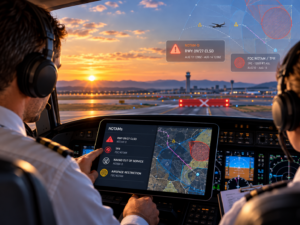
Pilot situational awareness encompasses the full scope of a pilot’s mental model: aircraft attitude, motion, position, system states, traffic, weather, and the ability to project how those factors will evolve. It is a comprehensive cognitive process spanning perception, comprehension, and anticipation.
Spatial disorientation is a subset of situational awareness loss — not a synonym. It occurs specifically when sensory illusions override instrument indications, causing pilots to misperceive aircraft attitude or motion. A pilot in IMC experiencing a somatogyral illusion — where the vestibular system falsely signals a turn has stopped, leading to a graveyard spiral — is experiencing spatial disorientation. These physiological mechanisms can override rational judgment with alarming speed.
Consider a different scenario: a pilot who loses track of fuel state during a diversion, or who forgets a NOTAM closing the destination runway. That pilot has experienced situational awareness loss without any spatial disorientation. This distinction matters because training programs must address the full spectrum of SA threats — not only vestibular illusions and unusual attitudes, but also the cognitive failures of task saturation, distraction, and incomplete mental models that erode awareness in less dramatic but equally dangerous ways.
Common Causes of Situational Awareness Loss in the Cockpit
FAA InFO 26003 and supporting research identify several conditions most commonly associated with situational awareness loss. Each represents a distinct threat to cockpit decision making:
- Low-light conditions (dawn, dusk, night): Reduced visual cues degrade depth perception and horizon reference, forcing greater reliance on instruments that pilots may not habitually scan in VMC.
- Lack of visual references (clouds, fog, haze, precipitation): Without an external visual horizon, the vestibular and somatosensory systems generate unreliable orientation data that can override instrument indications.
- Changing weather conditions: Deteriorating weather demands rapid reassessment of the flight plan, increasing cognitive load while simultaneously degrading the visual environment.
- High workload and task saturation: When demands exceed cognitive capacity, pilots unconsciously shed tasks — often losing awareness of critical flight parameters in the process.
- Distraction or interruption: A single unexpected event — a passenger question, an abnormal annunciation, a radio call at a critical phase — can break the scan pattern and disrupt the mental model.
- Fatigue or stress: Fatigued pilots process information more slowly, fixate more readily, and recover from errors less effectively.
These conditions rarely appear in isolation. A fatigued single-pilot operator flying at night into deteriorating weather faces multiple simultaneous SA threats. Single pilot resource management demands that solo pilots recognize these compounding risks and take proactive steps — including the decision not to fly — before the threats overwhelm their capacity.
FAA InFO 26003: What Part 135 and Part 91 Pilots Need to Know
FAA InFO 26003 represents the FAA’s current guidance on spatial disorientation and situational awareness training, issued in direct response to NTSB Safety Recommendation A-21-006. It applies to Part 91, Part 91K (fractional ownership), and Part 135 operators. This is recommended guidance — not a regulatory mandate. However, it represents the FAA’s current position on best practices and signals the direction of regulatory expectations. Operators and pilots who disregard it do so at their own risk.
The guidance recommends that training include ground-based academics, simulator training (where available), and flight training components. It emphasizes that scenario-based training combined with maneuver-based training is more effective than either approach alone. The specific recommendations differ by operational category — a distinction that many training resources fail to make clearly.
Part 135 Operator Obligations
FAA InFO 26003 recommends that Part 135 operators take the following steps to address situational awareness training:
- Develop and integrate spatial disorientation awareness procedures into general operations manuals
- Include avoidance strategies, recognition of onset, and recovery techniques
- Develop pilot training modules encompassing ground, simulator (if available), and flight training
- Integrate comprehensive SA training into existing recurrent training programs
While not mandatory, Part 135 operators who ignore this guidance face increased liability exposure and are out of step with industry best practices. These recommendations enhance the baseline competency framework established by 14 CFR § 135.293 (PIC qualifications) and § 135.295 (SIC qualifications). For Part 135 operators building or updating SA training programs, CTS offers structured training packages designed to address FAA InFO 26003 situational awareness training guidance.
Part 91 Pilot Best Practices
Part 91 pilots have no mandatory SA training requirement, but they are explicitly included in FAA InFO 26003’s applicability scope. The FAA recommends that Part 91 pilots:
- Participate in voluntary situational awareness training programs
- Maintain strong instrument scanning habits even in VFR conditions
- Complete thorough preflight weather briefings for every flight
- Establish and adhere to personal minimums that account for SA-degrading conditions
- Engage in regular hood work with qualified instructors
Single pilot resource management is the Part 91 equivalent of crew resource management — solo pilots must serve as their own safety net. There is no second crewmember to catch errors or challenge a deteriorating mental model. The recent flight experience requirements of 14 CFR § 61.57 support the argument for regular recurrent SA training, but proficiency demands more than minimum currency. Part 91 pilots seeking structured safety training should consider resources such as the IS-BAO/Part 91 training package to build disciplined SA habits.
Practical Techniques to Build and Maintain Situational Awareness
Situational awareness techniques only deliver results when practiced regularly. One-time exposure during initial training is not enough. The following methods, grounded in FAA guidance and proven training practice, apply directly to both multi-crew and single-pilot operations.
Verbal SA Mapping
Verbal SA mapping is one of the most effective situational awareness techniques for single-pilot operations — and one of the most underused. The technique requires pilots to periodically verbalize their current flight status aloud: “We are at 3,500 feet, 10 miles from the airport, descending for left traffic, gear is down, and I’m watching for traffic entering the pattern.”
Verbalization forces active cognitive engagement with the mental model. Passively monitoring instruments allows complacency to set in; stating your situation aloud demands that you synthesize information from multiple sources simultaneously. When something in the verbalized picture is wrong — an altitude that does not match the approach briefing, a configuration item missed — the act of saying it triggers immediate self-correction. For single-pilot operations, verbal SA mapping functions as a self-administered form of threat and error management.
Instrument Cross-Checking and Task Management
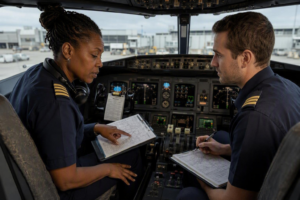
Effective instrument cross-checking means verifying consistency across multiple instruments rather than fixating on a single source. When the attitude indicator, altimeter, and vertical speed indicator all tell the same story, confidence in the mental model is high. When they diverge, that discrepancy is an early SA warning demanding immediate investigation.
Task management is the complementary discipline. Task saturation is one of the most common SA threats — when workload exceeds capacity, pilots shed tasks unconsciously, often losing awareness of critical flight parameters. The priority hierarchy is unambiguous: aviate, navigate, communicate. If you notice you are falling behind the aircraft, simplify. Engage the autopilot if available. Advise ATC. Refocus on primary flight instruments. Aviation workload management is not a sign of weakness — it is disciplined aviation decision making.
Recovery When Situational Awareness Is Lost
FAA InFO 26003 outlines a four-step recovery framework for pilots who recognize that situational awareness has degraded:
- Fly straight and level. Focus on flight instruments until regaining orientation. Stop maneuvering.
- Cross-check instruments. Verify consistency across all available sources to rebuild an accurate mental model.
- Communicate with ATC. Request assistance, declare the situation, and accept guidance. The NTSB Most Wanted List consistently highlights the importance of timely ATC coordination in loss-of-control situations.
- Use autopilot appropriately. Engage autopilot to maintain stability while regaining SA.
A critical caveat: autopilot is a recovery tool, not a substitute for SA maintenance. FAA InFO 26003 specifically identifies autopilot over-reliance as an SA risk factor. Pilots who habitually monitor autopilot performance maintain sharper awareness than those who disengage after engaging automation.
The FAA-Recommended Multi-Modal Training Approach
FAA InFO 26003 recommends a three-tier training model for building and maintaining situational awareness in aviation:
- Ground-based academics: Theoretical understanding of SA loss mechanisms, recognition of conditions conducive to SA degradation, recovery procedures, and aviation decision-making frameworks. This is the foundational layer.
- Simulator training: Scenario-based and maneuver-based exposure in a low-risk environment. Pilots can experience realistic SA-loss conditions — spatial disorientation, task saturation, weather deterioration — without the consequences of an actual aircraft.
- In-flight training: Hood work and real-world scenario exposure with qualified instructors. This layer translates academic knowledge and simulator experience into practiced cockpit discipline.
The FAA notes that scenario-based training combined with maneuver-based training produces higher effectiveness than either approach alone. Scenario-based training builds cockpit decision making and threat recognition; maneuver-based training builds the psychomotor skills and instrument scanning proficiency needed for recovery. According to AOPA’s training and safety resources, scenario-based instruction is among the highest-impact methods for reducing human-factors accidents.
Ground-based academics serve as the accessible, scalable foundation of this model. For geographically dispersed Part 135 crews who cannot easily assemble for classroom instruction, and for self-directed Part 91 pilots who lack regular simulator access, e-learning platforms provide the flexibility to complete rigorous ground-school training on a schedule that fits operational demands. Recurrent situational awareness training — annual or more frequent — should be built into the standard training cycle, not treated as an elective.
Common Misconceptions About Situational Awareness in Aviation
Misconception: “SA loss only affects inexperienced pilots.”
Reality: Loss of situational awareness affects pilots at every experience level. Experience builds proficiency, but it can also create overconfidence — particularly in familiar operating environments where complacency quietly erodes vigilance.
Misconception: “SA training is only relevant for IFR pilots.”
Reality: Situational awareness loss occurs in both VFR and IFR environments. VFR pilots lose SA through distraction, task saturation, unexpected weather changes, or unfamiliar airspace. FAA InFO 26003 recommends SA training for all Part 91 and Part 135 pilots regardless of the type of flying they do.
Misconception: “Once trained, SA loss won’t happen to me.”
Reality: SA loss is a recurring human factors challenge, not a problem solved by a single training event. The cognitive vulnerabilities that cause SA loss — fatigue, distraction, sensory illusions — are inherent to human physiology. Regular refresher training is what maintains proficiency throughout a career.
Misconception: “Relying on autopilot eliminates SA concerns.”
Reality: FAA InFO 26003 identifies autopilot over-reliance as an SA risk factor. Automation reduces workload, but it also reduces the active cognitive engagement that sustains awareness. Pilots who monitor automation critically maintain sharper SA than those who disengage after engaging the autopilot.
Building a Culture of Situational Awareness
Individual techniques matter, but lasting improvement in situational awareness requires a cultural commitment — at both the organizational and personal level.
For Part 135 operators, this means integrating SA procedures into general operations manuals as FAA InFO 26003 recommends, building SA training into recurrent programs, and creating non-punitive review environments where SA lapses are treated as learning opportunities rather than disciplinary events. Organizations that punish honest disclosure drive near-miss reports underground — and lose the data that prevents the next accident.
For Part 91 pilots, building a culture of situational awareness in aviation is a personal discipline. Commit to regular refresher training. Seek out structured SA curricula rather than relying solely on self-study. Set personal minimums that explicitly account for SA-degrading conditions — night, weather, fatigue, unfamiliar aircraft — and hold yourself to those minimums when operational pressure tempts you to push beyond them.
Situational awareness in aviation is not a skill mastered once during initial training. It is a discipline maintained throughout a career — through study, through practice, through honest self-assessment, and through structured cockpit decision making under pressure. The ground-school foundation of the FAA-recommended multi-modal training approach is now accessible through structured e-learning programs built specifically for this purpose.
Explore CTS’s aviation safety training programs designed to provide the ground-school foundation of the FAA-recommended multi-modal situational awareness training approach — built for Part 135 operators seeking compliance-ready curricula and Part 91 pilots committed to maintaining proficiency.