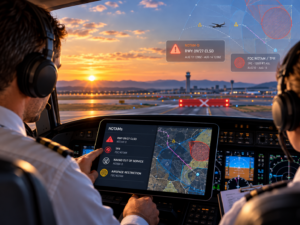
Traffic Collision Avoidance System (TCAS): What Part 135 Operators Need to Know
Why Traffic Collision Avoidance System Compliance Matters More Than Ever for Part 135 Operations
Studies indicate that immediate compliance with a TCAS Resolution Advisory reduces mid-air collision risk by over 90% — yet failure to respond to an RA remains a primary cause of mid-air collision events in congested airspace. For Part 135 operators, understanding your traffic collision avoidance system obligations is not optional: the margin between a routine flight and a catastrophic outcome often comes down to seconds of trained response.
Part 135 operators face a convergence of pressures that demand renewed attention to collision avoidance systems. Traffic density continues to increase at major hubs — TCAS alerts at Denver International Airport occur multiple times per hour during peak traffic, as documented in SAFO 22003. The regulatory environment is shifting as well: the SMS compliance deadline of May 28, 2027 requires operators to integrate TCAS safety data into formal risk management processes. And a generational technology transition from TCAS II to ACAS X is already underway.
This article is a practical operational guide written specifically for Part 135 certificate holders, training managers, and chief pilots. It covers the regulatory requirements under FAR 135.180, the critical distinctions between system types, training obligations aligned with current FAA safety alerts, ADS-B In integration, and what the ACAS X transition means for your fleet. Consider it a briefing document for keeping your operation compliant, your crews prepared, and your passengers protected.
FAR 135.180 TCAS Requirements: Which System Does Your Fleet Need?
The regulatory mandate for traffic collision avoidance system equipment in Part 135 operations is defined under 14 CFR § 135.180. This regulation establishes clear thresholds based on passenger seating configuration — not the number of passengers actually on board for a given flight. Misunderstanding this distinction is one of the most common compliance errors in Part 135 operations.
Here are the FAR 135.180 TCAS requirements, stated plainly:
- TCAS I is required for Part 135 aircraft with a passenger seating configuration of 10 to 30 seats. TCAS I provides Traffic Advisories (TAs) only — it alerts the crew to nearby traffic but does not issue Resolution Advisories or direct escape maneuvers.
- TCAS II is required for Part 135 aircraft with a passenger seating configuration of more than 30 seats. TCAS II provides both TAs and RAs, including coordinated vertical escape maneuver directives.
Not all Part 135 aircraft require TCAS II. If your fleet consists of aircraft configured with 30 or fewer passenger seats, TCAS I satisfies the regulatory requirement. Aircraft with fewer than 10 passenger seats are not subject to the TCAS mandate under 14 CFR § 135.180, though operators may voluntarily equip them.
Operational use requirements are further defined under 14 CFR § 91.221, which prohibits operating an aircraft without the required TCAS equipment when mandated by certificate or configuration. Advisory Circular AC 135-44 provides configuration inspection guidance for FAA inspectors and operators verifying that aircraft added to a Part 135 certificate meet all equipment requirements, including TCAS installation. For comprehensive Part 135 regulatory training, explore CTS’s Part 135 Training package.
TCAS I vs. TCAS II vs. ACAS X: A Quick Comparison
Understanding the differences between TCAS I, TCAS II, and the emerging ACAS X is essential for fleet planning and training curriculum development.
- TCAS I: Provides Traffic Advisories only. No Resolution Advisories. No escape maneuver commands. Required for Part 135 aircraft with 10–30 passenger seats. Enhances situational awareness but relies entirely on pilot judgment for avoidance maneuvers.
- TCAS II (Version 7.1): Provides both Traffic Advisories and Resolution Advisories, including coordinated vertical escape maneuvers. The current mandated standard is Version 7.1, which includes enhanced alert logic and ADS-B In integration. Required for Part 135 aircraft with more than 30 passenger seats.
- ACAS X (Next Generation): A software-defined airborne collision avoidance system designed to replace TCAS II. Capable of 4D trajectory-based avoidance — not limited to vertical maneuvers alone. The FAA expects initial operational concepts to be validated by 2027, with a projected 80% commercial operator adoption by 2030. ACAS X is not yet mandated but will eventually supersede TCAS II.
How TCAS Works: Traffic Advisories vs. Resolution Advisories
TCAS operates on a two-tier alert system built on transponder-based collision avoidance. The system interrogates transponder signals from nearby aircraft to determine range, bearing, altitude, and closure rate. Understanding what each tier demands from the flight crew is fundamental to safe operations.
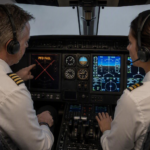
A Traffic Advisory (TA) is the first level of alert. It indicates a potential threat — an aircraft that has entered the system’s caution area. When a TA is issued, pilots should increase visual scanning and monitor the traffic on their TCAS display. A TA does not require an avoidance maneuver. It is an awareness tool, not an action directive.
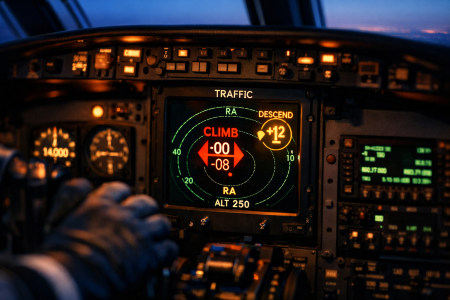
A Resolution Advisory (RA) is the second level and demands immediate action. An RA indicates an imminent collision threat and provides a specific maneuver command — typically a directive to climb or descend at a prescribed rate. Pilots must respond to an RA within 5–10 seconds. There is no time for deliberation.
Two critical points that experienced pilots sometimes get wrong: First, when an RA conflicts with ATC instructions, the RA takes priority. Pilots must follow the RA and notify ATC as soon as practicable — this is established FAA policy, not a discretionary call. Second, TCAS relies on transponder interrogation signals and cannot account for weather-induced deviations. TCAS is a backup collision avoidance system, not a replacement for ATC separation services.
ADS-B In Traffic Awareness and Its Relationship to Your Traffic Collision Avoidance System
ADS-B In technology provides real-time, high-fidelity traffic data by receiving position broadcasts directly from nearby aircraft. This capability enhances situational awareness significantly, giving crews a more complete picture of surrounding traffic than transponder interrogation alone can provide.
TCAS II Version 7.1 includes enhanced ADS-B In surveillance integration, allowing the system to incorporate ADS-B In data for more precise Resolution Advisories in mixed surveillance environments. Industry safety experts describe the ADS-B/TCAS integration as a meaningful advancement for traffic awareness — and the operational benefits are real.
However, operators must understand a critical distinction: ADS-B In does not replace TCAS for collision avoidance purposes. It improves the quality of traffic information available to the crew and the TCAS processor, but it does not independently generate Resolution Advisories. TCAS remains the primary system responsible for issuing escape maneuver commands. Your training programs should reinforce this distinction clearly, especially as TCAS II Version 7.1 ADS-B integration becomes a standard component of recurrent curricula.
TCAS Resolution Advisory Training: What Your Program Must Include
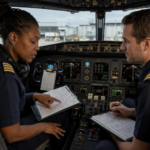
Training is where compliance meets operational reality. SAFO 11010 provides detailed TCAS II training requirements for Part 135 and Part 125 certificate holders and should serve as the baseline for your RA training program. If your recurrent training curricula have not been audited against SAFO 11010 guidance recently, that audit is overdue.
Your TCAS training program must address these essential elements:
- RA Response Drills: Pilots must practice executing vertical escape maneuvers within the 5–10 second RA response window. Whether conducted in simulators or reinforced through e-learning scenarios, these drills must emphasize that hesitation increases collision risk. Failure to respond to an RA is a leading factor in mid-air collision incidents.
- TCAS II Version 7.1 Updates: Update your e-learning modules to reflect current TCAS II Version 7.1 features, including improved alert logic and ADS-B In integration. Crews operating with outdated system knowledge create unnecessary risk.
- RA/ATC Conflict Protocols: Ensure your training includes clear decision protocols for when an RA conflicts with ATC instructions. The RA takes priority — every time. This must be drilled until the response is automatic.
- High-Density Airspace Scenarios: Incorporate scenario-based training for operations in high-density airspace environments where frequent TCAS alerts are documented.
The NBAA Part 135 Operations guidance emphasizes that misuse of collision avoidance technology remains a significant safety concern. AOPA reinforces that RA response training must be a core component of pilot proficiency. For a structured approach to TCAS RA response training, see CTS’s TCAS II Training Course.
High-Density Airspace Scenarios: Lessons from Denver
SAFO 22003 specifically addresses TCAS II alert patterns at Denver International Airport, where high traffic density during peak operations can trigger TAs and RAs multiple times per hour. This is not a hypothetical training scenario — it is a documented, recurring operational condition.
Operators flying into DEN or similar high-density airspace should incorporate these specific alert patterns into both simulator sessions and e-learning modules. Crews who have rehearsed the rapid decision-making required when multiple alerts occur in quick succession will perform markedly better than those encountering it for the first time on a live approach.
TCAS Data and Your Safety Management System (SMS)
Under 14 CFR Part 5, 100% of Part 135 operators must have a compliant Safety Management System (SMS) by May 28, 2027. This regulatory framework requires operators to establish formal processes for hazard identification and risk assessment — and TCAS safety data must be part of that system.
In practice, this means your operation needs documented procedures for pilots to report TCAS anomalies, track RA and TA event data, and feed that information into your SMS hazard analysis processes. Crews are often trained on how to respond to TCAS alerts but not on how to report and document them within the SMS framework. Closing that gap before the 2027 deadline should be a priority now.
Every RA event is a data point. Every unreported event is a missed opportunity to identify systemic risks — whether those risks involve specific airspace, specific aircraft, or specific crew performance patterns. Your SMS is only as effective as the data you feed it.
ACAS X: Preparing for the Next Generation of Collision Avoidance
The FAA’s next-generation airborne collision avoidance system, ACAS X, represents the most significant upgrade to collision avoidance technology since TCAS II was introduced. According to the FAA ACAS Program Office, ACAS X will provide more flexible and adaptive collision avoidance compared to the current system.
The key differences are architectural. ACAS X is software-defined, making it more adaptable to updates and new operational environments. Rather than relying solely on vertical escape maneuvers, ACAS X uses 4D trajectory-based avoidance — accounting for lateral position and time in addition to altitude. This flexibility matters as airspace grows more complex and traffic types more diverse, including unmanned aircraft systems.
The FAA expects initial operational concepts to be validated by 2027, with a projected 80% commercial operator adoption by 2030. While ACAS X is not yet mandated, the transition planning window is open now. Operators who begin introducing ACAS X concepts into recurrent training — even at a foundational level — will be better positioned when the regulatory mandate arrives.
Frequently Asked Questions About TCAS for Part 135 Operators
What are the TCAS requirements for Part 135 operators?
Under 14 CFR § 135.180, Part 135 aircraft with a passenger seating configuration of 10–30 seats must be equipped with TCAS I. Aircraft with more than 30 passenger seats must be equipped with TCAS II. These thresholds are based on seating configuration, not actual passenger count.
What is the difference between a TCAS traffic advisory and a resolution advisory?
A Traffic Advisory (TA) alerts the crew to a potential traffic conflict and calls for increased visual scanning and monitoring. A Resolution Advisory (RA) indicates an imminent collision threat and commands an immediate vertical maneuver — climb or descend. A TA is advisory; an RA is directive.
Do all Part 135 aircraft require TCAS II?
No. Only Part 135 aircraft configured with more than 30 passenger seats require TCAS II. Aircraft with 10–30 passenger seats require TCAS I. Aircraft with fewer than 10 passenger seats are not subject to the TCAS mandate under FAR 135.180.
How should a pilot respond to a TCAS resolution advisory?
Pilots must execute the commanded vertical maneuver within 5–10 seconds. If the RA conflicts with ATC instructions, the RA takes priority. The pilot must follow the RA, then notify ATC as soon as practicable. Deferring to ATC during an active RA increases collision risk.
Will ACAS X replace TCAS II for Part 135 operators?
Yes, ACAS X is designed to replace TCAS II as the standard airborne collision avoidance system. The FAA expects operational validation by 2027 and projects 80% commercial operator adoption by 2030. ACAS X is not yet mandated, but operators should begin familiarizing crews with the technology now.
Staying Ahead: Your Traffic Collision Avoidance System Compliance Action Plan
A traffic collision avoidance system is not a set-it-and-forget-it solution. It demands ongoing compliance verification, current training programs, and strategic transition planning. The regulatory environment, the technology, and the airspace environment are all evolving — and your operation must evolve with them.
Here are four immediate action items for your operation:
- Verify fleet TCAS compliance: Confirm that every aircraft on your certificate meets the FAR 135.180 TCAS requirements based on passenger seating configuration. Document compliance status for each airframe.
- Audit your TCAS RA training program: Review your recurrent training curricula against SAFO 11010 guidance and TCAS II Version 7.1 updates. Ensure RA response drills, ATC conflict protocols, and high-density airspace scenarios are included.
- Integrate TCAS event reporting into your SMS: Build formal procedures for RA/TA reporting and data tracking before the May 28, 2027 SMS compliance deadline. Every TCAS event should feed your hazard identification process.
- Introduce ACAS X concepts into recurrent training: Begin familiarizing crews with the ACAS X architecture and 4D trajectory-based avoidance concepts. The FAA projects widespread adoption by 2030 — preparation starts now.
Keeping your traffic collision avoidance system training program current is one of the most impactful steps you can take to protect your crews and passengers. CTS offers comprehensive, regulation-aligned training to help your operation stay compliant and prepared. Explore CTS’s TCAS II Training Course and Part 135 Training packages to ensure your program meets today’s requirements — and tomorrow’s.