
Discover the Critical Angle of Attack
The critical angle of attack is the maximum angle between the wing’s chord line and the relative wind at which lift can be maintained. When this angle is exceeded, airflow separates from the wing, lift decreases abruptly, and the aircraft stalls. This fundamental aerodynamic limit exists regardless of aircraft type, pilot experience, altitude, weight, or power setting. Understanding this concept is essential because stalls are not caused by low airspeed—they are caused by exceeding the critical angle of attack.
Why airspeed alone is an incomplete indicator
Pilots are taught to associate stalls with specific airspeeds, but airspeed is only an indirect reference. Published stall speeds assume a specific configuration, load factor, and flight condition. In real-world operations, those conditions are constantly changing. An aircraft can reach its critical angle of attack at a wide range of airspeeds, depending on how it is flown. This is why relying solely on airspeed can create a false sense of safety, especially during maneuvering flight or high-workload phases.
Factors that change stall speed—but not the critical angle of attack—include:
- Aircraft weigh
- Load factor (G-forces)
- Bank angle
- Turbulence or abrupt control inputs
The wing always stalls at the same critical angle of attack—the airspeed at which it happens is what changes.
Configuration changes and their aerodynamic effects
Aircraft configuration influences how much margin exists between normal flight and the wing’s critical angle of attack. Flap extension, landing gear deployment, and external drag all affect airflow and required pitch attitude. While flaps generally lower stall speed by increasing lift capability, they also alter wing camber and drag, which can mask how quickly angle of attack is increasing. Similarly, landing gear extension and high-drag configurations often require higher pitch attitudes to maintain performance, bringing the wing closer to its aerodynamic limit.
Common configuration considerations include:
- Flaps lowering stall speed but increasing drag
- Gear extension increasing power and pitch demands
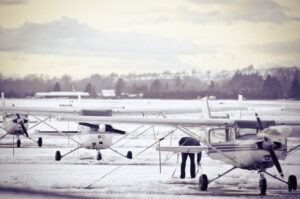
- Ice contamination reducing lift and stall margin
- Go-arounds requiring rapid pitch and power changes
These variables make it clear why airspeed alone cannot reliably predict an impending stall.
The importance of angle of attack awareness
Angle of attack is the only direct indicator of how close a wing is to stalling. Unlike airspeed, it automatically accounts for weight, configuration, load factor, and atmospheric conditions. This makes angle of attack awareness especially valuable during takeoff, approach, maneuvering, and go-around phases of flight—times when pilots are often task-saturated and operating close to aerodynamic limits.
Angle of attack awareness provides pilots with:
- Consistent stall margin information in all configurations
- Earlier and more intuitive warning of an impending stall
- Improved approach and performance consistency
- Enhanced safety during maneuvering flight
It answers the most critical question a pilot can ask: How close is my wing to stalling right now?
Why this matters for all pilots
For both general aviation and professional pilots, understanding the critical angle of attack shifts stall prevention from memorization to comprehension. While airspeed remains an important performance reference, it should never be the sole cue for stall avoidance. Recognizing that the wing does not care about numbers on an airspeed indicator, only angle of attack, leads to safer decision-making and better aerodynamic control. Mastery of this concept forms the foundation for understanding accelerated stalls, load factor in turns, and loss-of-control prevention—topics that every pilot must continually revisit throughout their flying career.
Conclusion
Understanding the critical angle of attack is only the first step. In real-world flying, pilots most often exceed this aerodynamic limit not in straight-and-level flight, but during maneuvering—especially in turns where load factor quietly increases the wing’s demand for lift. In the next article, we’ll explore how G-forces, bank angle, and load factor can drive an aircraft to its critical angle of attack at unexpectedly high airspeeds, and why recognizing this relationship is essential to preventing loss-of-control accidents.
RELATED CTS TRAINING
RELATED CTS TRAINING