
“Mayday” | Its Meaning and Use in Aviation
In-Flight Safety » Page 4A Brief History of “Mayday” The term “Mayday” is one of the most recognized distress calls in the world. It was originally coined in the 1920s by Frederick Mockford, a senior

In-Flight Safety » Page 4A Brief History of “Mayday” The term “Mayday” is one of the most recognized distress calls in the world. It was originally coined in the 1920s by Frederick Mockford, a senior

In-Flight Safety » Page 4Is Helicopter Flight Training with NVGs Helicopter flight training equips pilots for a wide range of challenging missions, and one of the most vital tools in nighttime operations is the night

In-Flight Safety » Page 4Pilot Training and Spatial Disorientation Pilot training often emphasized the importance of maintaining situational awareness, but few threats are as insidious—or as deadly—as spatial disorientation. For generations, instructors have drilled into

In-Flight Safety » Page 4Understanding the Critical Role of Angle of Attack in Aviation In the realm of aviation, few concepts are as fundamental and yet as nuanced as the angle of attack (AoA). For

In-Flight Safety » Page 4Among the various classifications of airspace, Class E airspace often requires a nuanced understanding because of its widespread nature and unique regulations. Whether you’re operating under VFR or IFR, knowing how

In-Flight Safety » Page 4Mastering Autorotation in Flight Training Autorotation is a cornerstone of helicopter safety flight training—an emergency descent technique that every student must master. When engine power is lost, autorotation allows the helicopter

In-Flight Safety » Page 4Traditional Navigation Still Matters in Flight Training In modern airplanes, it’s easy to get swept up by sleek touchscreen panels, real-time weather overlays, and the reassuring magenta line guiding every turn.

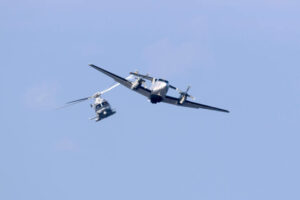
In-Flight Safety » Page 4Flight Training to See and Be Seen Mid-air collisions are among the most tragic and avoidable accidents in aviation. Despite technological advances, recent events—including the Potomac River mid-air collision between a

In-Flight Safety » Page 4Class E Airspace Navigating Class E airspace can be a routine part of flying and it’s essential to prioritize both safety and efficiency. Class E airspace comes with certain rules and

In-Flight Safety » Page 4Building a Safety Culture in Part 135 In the world of Part 135 charter flying, safety isn’t just about procedures; it’s about people. While the FAA establishes the regulatory framework, it’s

In-Flight Safety » Page 4A Brief History of “Mayday” The term “Mayday” is one of the most recognized distress calls in the world. It was originally coined in the 1920s by Frederick Mockford, a senior

In-Flight Safety » Page 4Is Helicopter Flight Training with NVGs Helicopter flight training equips pilots for a wide range of challenging missions, and one of the most vital tools in nighttime operations is the night

In-Flight Safety » Page 4Pilot Training and Spatial Disorientation Pilot training often emphasized the importance of maintaining situational awareness, but few threats are as insidious—or as deadly—as spatial disorientation. For generations, instructors have drilled into

In-Flight Safety » Page 4Understanding the Critical Role of Angle of Attack in Aviation In the realm of aviation, few concepts are as fundamental and yet as nuanced as the angle of attack (AoA). For

In-Flight Safety » Page 4Among the various classifications of airspace, Class E airspace often requires a nuanced understanding because of its widespread nature and unique regulations. Whether you’re operating under VFR or IFR, knowing how

In-Flight Safety » Page 4Mastering Autorotation in Flight Training Autorotation is a cornerstone of helicopter safety flight training—an emergency descent technique that every student must master. When engine power is lost, autorotation allows the helicopter

In-Flight Safety » Page 4Traditional Navigation Still Matters in Flight Training In modern airplanes, it’s easy to get swept up by sleek touchscreen panels, real-time weather overlays, and the reassuring magenta line guiding every turn.

In-Flight Safety » Page 4Flight Training to See and Be Seen Mid-air collisions are among the most tragic and avoidable accidents in aviation. Despite technological advances, recent events—including the Potomac River mid-air collision between a

In-Flight Safety » Page 4Class E Airspace Navigating Class E airspace can be a routine part of flying and it’s essential to prioritize both safety and efficiency. Class E airspace comes with certain rules and

In-Flight Safety » Page 4Building a Safety Culture in Part 135 In the world of Part 135 charter flying, safety isn’t just about procedures; it’s about people. While the FAA establishes the regulatory framework, it’s