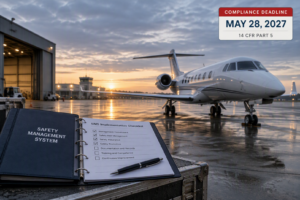

Emergency Landing Procedures Every Part 135 and Part 91 Pilot Should Know
Introduction: Why Emergency Landing Mastery Saves Lives
Approximately 20% of all general aviation accidents involve forced landings or engine-related failures — yet 85% of survivable emergency landings are associated with pilots who followed a single foundational principle: fly the airplane first. An emergency landing is not a hypothetical scenario reserved for checkride oral exams. It is a real, statistically significant event that demands procedural discipline, situational awareness, and trained reflexes from every pilot in command.
Whether you operate under Part 91 or Part 135, the core emergency landing procedures remain the same — but the regulatory obligations, training requirements, and operational context differ significantly. Part 135 emergency declarations rose 12% in 2025, largely attributed to mechanical issues, according to FAA Air Flight Standards data. That trend alone underscores why this topic demands renewed attention across the industry. For pilots seeking structured online training, CTS offers Part 135 and IS-BAO/Part 91 programs that include emergency procedure modules.
This article provides a single, comprehensive resource: the foundational Aviate, Navigate, Communicate framework; a step-by-step forced landing checklist; the critical distinction between forced and precautionary landings; a side-by-side Part 91 vs. Part 135 regulatory comparison; passenger briefing guidance; and post-landing procedures. Every section is built to strengthen your airmanship when it matters most.
Aviate, Navigate, Communicate: The Foundation of Every Emergency Landing
Every emergency landing begins with the same three priorities, executed in order: Aviate, Navigate, Communicate. This sequence is not a suggestion. According to the AOPA Air Safety Institute (2025), 85% of survivable emergency landings are associated with pilots who maintained aircraft control as their first action. Deviate from this order, and the odds shift against you.
Aviate. Maintain aircraft control. Establish best glide speed immediately — this is the airspeed that gives you the maximum distance for altitude lost. Do not chase the cause of the failure before stabilizing the aircraft. Pitch for best glide, trim, and fly the airplane.
Navigate. Select the best available landing site. Apply sound emergency landing field selection criteria: a runway is preferred, then a road or highway free of obstacles, then an open field — flat, dry, and into the wind. Evaluate your altitude, distance, and wind direction. Commit to your field early and plan your approach pattern to reach it.
Communicate. Declare an emergency on the active ATC frequency or 121.5 MHz. Squawk 7700. State your aircraft type, position, intentions, and number of souls on board. Radio calls do not keep the airplane flying. Communication comes third for a reason.
14 CFR §91.3 grants the pilot in command the authority and responsibility to deviate from any rule to the extent required to meet an emergency. That authority exists because the FAA recognizes that rigid compliance can cost lives when the engine quits. Know this regulation. Use it when you must.
Forced Landing Checklist: Step-by-Step Engine Failure Emergency Landing Procedure
The following engine failure emergency landing procedure is designed as a scannable, printable reference. Practice it until these steps are reflexive — not recited.
- Establish best glide speed immediately. Pitch for the airspeed specified in your POH. Trim to maintain it hands-off if possible.
- Select the best available landing field. Prioritize: runway, then road, then open field. Evaluate wind, slope, surface, and obstacles. Commit early.
- Attempt engine restart if altitude permits. Check fuel selector (switch tanks), mixture rich, magnetos both, carburetor heat ON. Cycle the primer. If the engine responds, assess whether continued flight is safe.
- If restart fails: secure the engine. Fuel selector OFF. Mixture idle cut-off. Magnetos OFF. This reduces fire risk on impact.
- Declare emergency. Transmit on ATC frequency or 121.5 MHz. Squawk 7700. State position, altitude, intentions, souls on board.
- Brief passengers. Direct and calm: tighten seatbelts, assume brace position, remain seated until the aircraft stops, exit toward the upwind side, move away from the aircraft.
- Master switch OFF just before touchdown — unless you need electrical power for flaps or landing gear extension.
- Fly the airplane all the way to the ground. Do not stall early. Maintain a controlled descent. Use flaps as appropriate for a short-field approach. Touch down at the lowest controllable airspeed.
- Post-landing: exit upwind, move all occupants at least 100 feet from the aircraft, and contact emergency services via cell phone or handheld radio.
This forced landing checklist must be practiced — not memorized from a page and filed away. The engine-out procedure demands muscle memory and procedural discipline under stress. FAA 2025 data shows that checkride failure rates for emergency procedures in Part 135 operations run between 8–10%. That figure represents a real training gap, meaning roughly one in ten Part 135 pilots tested cannot demonstrate proficiency in the procedure that matters most during an off-airport landing scenario.
Precautionary Landing vs. Forced Landing: Know the Difference
A forced landing occurs when the pilot has no choice — engine failure, structural compromise, or another condition makes continued flight impossible. Power is gone. The landing is immediate and mandatory. A precautionary landing, by contrast, occurs while the engine is still producing power, but conditions — deteriorating weather, low fuel state, a mechanical warning, or a sick passenger — make continued flight inadvisable. The pilot elects to land. Power is available, but the safety margin is shrinking.
The international framework from CASA and ICAO distinguishes between prepared and unprepared emergency landings. A prepared emergency landing allows time for cabin preparation, passenger briefings, and deliberate field selection. An unprepared landing demands instant execution with no lead time. This distinction is underrepresented in U.S.-centric training content, yet it directly shapes how pilots manage each scenario.
A precautionary landing is a proactive safety decision — not a failure of airmanship. CASA analysis shows that 70% of precautionary landings result in successful outcomes when passengers receive proper pre-landing briefings. Pilots should also challenge the assumption that they must always aim for a runway. In many precautionary scenarios, the nearest suitable field or road offers a greater safety margin than pressing on toward a distant airport.
Part 91 vs. Part 135: How Emergency Landing Requirements Differ
The following breakdown compares Part 91 and Part 135 emergency landing obligations across five critical dimensions.
Regulatory Authority. 14 CFR §91.3 grants all pilots in command — Part 91 and Part 135 alike — the authority to deviate from any regulation to the extent required to meet an emergency. However, Part 135 adds compliance layers under 14 CFR §135.25, which requires operators to maintain manuals that include emergency procedures. The pilot-in-command authority is the same; the documentation and oversight surrounding it are not.
Passenger Briefing. 14 CFR §135.117 mandates that Part 135 operators brief passengers before each flight on emergency procedures, exits, and safety equipment. Many Part 91 pilots mistakenly believe passenger safety briefings are a Part 135-only obligation. They are not. When passengers are aboard any flight, the PIC bears responsibility for their awareness and preparation — a principle reinforced by both FAA guidance and crew resource management doctrine.
Equipment Standards. Part 91 allows operational flexibility — for example, non-TSO life rafts may be acceptable for certain overwater operations. Part 135 mandates stricter, FSDO-overseen equipment standards that leave less room for operator discretion. Emergency equipment lists are audited, not self-certified.
Training and Recurrency. This is where the gap widens most. 14 CFR §135.293 establishes testing requirements for Part 135 pilots, including demonstrated proficiency in emergency procedures. 14 CFR §135.299 mandates flight checks that specifically evaluate emergency competency. Part 91 pilots face no equivalent recurring mandate beyond the flight review required under §61.56 — a review that may or may not include rigorous emergency procedure testing at the instructor’s discretion.
Oversight. Part 135 operators are subject to FSDO oversight, including evaluations of emergency procedure proficiency. Part 91 operations are largely self-regulated, which means Part 91 pilots must hold themselves to a higher standard voluntarily. CTS training programs address both Part 91 and Part 135 emergency procedure requirements for pilots who want structured recurrent proficiency regardless of their operating certificate.
Passenger Briefing During an Emergency: What Every Pilot Must Say
Many GA pilots operating under Part 91 skip passenger briefings entirely, assuming that requirement belongs to Part 135 alone. This is a dangerous misconception. A calm, direct briefing during an emergency can mean the difference between a survivable outcome and cabin chaos.
Here is a practical emergency passenger briefing script — adapt it to your aircraft and situation:
- “Tighten your seatbelts as tight as they will go.”
- “Assume the brace position — head down, hands behind your head, lean forward against the seat in front of you.”
- “Remain seated until the aircraft comes to a complete stop.”
- “When I say ‘go,’ exit toward the left/right side” (specify the upwind side). “Move away from the aircraft immediately.”
- “Do not take any belongings with you.”
This is crew resource management (CRM) in its most direct form. Even in a single-pilot GA cockpit, managing passenger behavior is CRM. CASA’s advisory circulars emphasize the use of briefing cards for precautionary landings — a practice that applies equally to Part 91 and Part 135 operations. The data supports it: 70% of precautionary landings result in successful outcomes when passengers receive proper pre-landing briefings.
Post-Landing Emergency Procedures: What Happens After Touchdown
The post-landing phase is critically underrepresented in pilot emergency procedures training, yet it is a direct link in the survival chain. After touchdown, execute the following steps:
- Exit the aircraft on the upwind side to avoid fuel vapors and potential fire hazards downwind.
- Move all occupants at least 100 feet from the aircraft. Do not linger near the fuselage or wings.
- Contact emergency services immediately. Use a cell phone or handheld radio. NBAA recommends carrying a handheld radio specifically for post-landing communications when ground-based infrastructure is unavailable.
- Secure the scene if it is safe to do so. Mark the aircraft location for responders if practical.
- Do NOT re-enter the aircraft unless a life is at immediate risk. Fuel leaks and electrical hazards may not be visible.
Training to Proficiency: How Pilots Can Stay Sharp on Emergency Landing Procedures
Knowledge without practice is a checklist you cannot execute under pressure. Part 135 pilots must demonstrate emergency landing procedures proficiency during recurrent training checks under 14 CFR §135.293. Part 91 pilots should seek equivalent rigor voluntarily — because the engine does not care which part you fly under when it quits.
The training environment is evolving. The FAA has signaled support for VR simulator forced landing training under the ASPFOR 2026 initiative, recognizing that immersive simulation builds the procedural discipline that classroom instruction alone cannot provide. FAA WINGS credits are now available for online emergency landing training modules, giving pilots a structured path to recurrent proficiency without scheduling conflicts. Gamified glide-to-land simulation exercises are gaining traction in both Part 91 and Part 135 training programs, turning repetitive practice into measurable skill-building.
The urgency is real. A 15% rise in Part 135 engine-out events was reported in 2025, attributed in part to fuel supply chain disruptions affecting fuel quality and availability. General Aviation News (October 2025) called for expanded training syllabi covering both emergency and non-emergency scenarios — including fuel management to prevent forced landings — recognizing that the best emergency landing is the one that never happens.
Structured online training programs bridge the gap between knowledge and proficiency, making emergency landing procedures second nature before they are ever needed in the cockpit. Strengthen your emergency procedure proficiency with FAA-aligned training. Explore CTS’s Part 135 Training and IS-BAO/Part 91 Training programs to ensure you and your crew are prepared for every scenario — from engine failure to precautionary landing.
Frequently Asked Questions About Emergency Landing Procedures
What is the correct sequence for an emergency landing?
Aviate, Navigate, Communicate. Establish best glide speed to maintain aircraft control, select the best available landing field, then declare an emergency on the active ATC frequency or 121.5 MHz and squawk 7700. Aircraft control is always the first priority.
What is the difference between a forced landing and a precautionary landing?
A forced landing occurs when engine failure or another critical condition makes continued flight impossible — there is no power, and the landing is immediate. A precautionary landing occurs when power is available, but the pilot determines that deteriorating conditions — weather, fuel state, or a mechanical warning — make continued flight inadvisable. The pilot elects to land as a proactive safety decision.
What are the FAA requirements for emergency landing procedures under Part 135?
14 CFR §135.293 establishes testing requirements that include demonstrated proficiency in emergency procedures. 14 CFR §135.299 mandates flight checks that evaluate emergency competency. Additionally, 14 CFR §135.117 requires operators to brief passengers on emergency procedures before each flight.
When should a pilot declare an emergency on 121.5 MHz?
A pilot should declare an emergency on 121.5 MHz whenever the situation poses a safety risk and contact with ATC on the assigned frequency is not possible. There is no penalty for declaring — the emergency frequency exists to save lives.
How do you brief passengers during an emergency landing?
Deliver calm, direct instructions: tighten seatbelts, assume the brace position, remain seated until the aircraft comes to a complete stop, exit toward the upwind side, and move away from the aircraft immediately. Clarity under stress saves lives.