Part 135 IIMC Training: Recognition, Recovery, and Risk Reduction
A helicopter pilot who inadvertently continues VFR flight into instrument meteorological conditions faces a median time to loss of control — and death — of just 56 seconds. That is not enough time to plan. It is barely enough time to react. It is why Part 135 IIMC awareness training is not optional preparation — it is survival training.
The 56-Second Problem: Why IIMC Is Helicopter Aviation’s Most Urgent Threat
Fifty-six seconds. That statistic, commonly cited across helicopter safety analysis, represents the median interval between a VFR helicopter pilot’s inadvertent entry into instrument meteorological conditions and a fatal loss of control. It does not allow for deliberation, troubleshooting, or creative problem-solving. It is a survivability event measured in heartbeats, and it demands that IIMC awareness training Part 135 operators provide be treated with the same rigor as emergency procedure training for engine failures or in-flight fires.
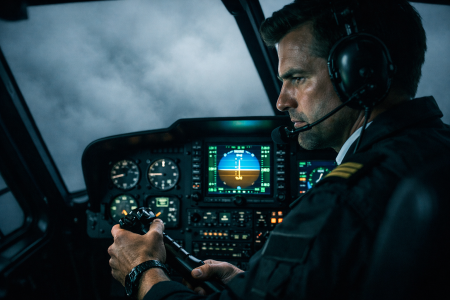
IIMC — inadvertent instrument meteorological conditions — occurs when a flight operating under visual flight rules unintentionally encounters conditions that eliminate external visual cues. The pilot loses the horizon, loses terrain references, and enters an environment where spatial disorientation can onset within seconds. This is not a weather navigation challenge. It is a loss-of-control emergency with an extraordinarily compressed decision window.
Across the rotorcraft industry, IIMC is widely recognized as one of the most dangerous operational hazards in helicopter operations. This article addresses how Part 135 helicopter IIMC training should be structured around three pillars: recognition, recovery, and risk reduction. Each pillar reinforces the others. None is sufficient alone.
What Makes IIMC Different from a Routine Weather Deviation
Planned IFR flight and routine weather diversions share a critical characteristic: the pilot expects reduced visibility and prepares accordingly. IIMC eliminates that expectation entirely. The transition from visual to instrument conditions is sudden, unplanned, and often occurs while the pilot is already in a high-workload, low-altitude environment — confined areas, terrain-following routes, approach corridors — where altitude margins are minimal and escape options are constrained.
Helicopter operations carry unique IIMC risk factors that fixed-wing operations do not. Low-level flight, confined landing zones, and the high visual workload inherent in rotorcraft maneuvering mean that the loss of visual reference can be immediately catastrophic. The pilot is not cruising at altitude with time to assess. The pilot is close to terrain, possibly decelerating, and relying entirely on outside cues that have just vanished.
A persistent and dangerous misconception is that a skilled VFR pilot can improvise an escape from inadvertent instrument meteorological conditions. The evidence says otherwise. VFR flight into IMC triggers spatial disorientation so rapidly that cognitive capacity degrades before the pilot can formulate a plan. Experienced commercial crews are vulnerable — not just low-time pilots. The time-critical nature of the event makes pre-briefed, immediate responses essential, not optional.
Regulatory Framework: Part 135 IIMC Awareness Training Requirements
14 CFR Part 135 governs commuter and on-demand operations, including the training and checking standards that apply to many helicopter commercial operators. For Part 135 helicopter IIMC training, the regulatory mechanism is typically the operator’s approved training program, company SOPs, and checking events — not a stand-alone IIMC lesson mandated by a single regulation. This means the quality and depth of IIMC training depends heavily on how the operator designs and implements its program.
FAA rulemaking in adjacent commercial rotorcraft sectors has been moving toward performance-based training standards comparable to Part 135 Subpart H. The FAA’s Commercial Air Tour Aviation Rulemaking Committee report reflects this direction, emphasizing measurable outcomes and risk-based oversight rather than minimum task completion. This trend reinforces the principle that IIMC awareness training Part 135 programs deliver should be evaluated by what pilots can demonstrably do under realistic conditions — not by whether a box was checked.
Safety management system principles underpin this evolution. SMS frameworks call for data-driven identification of operational hazards, and IIMC ranks high on that list. Organizations like Boston MedFlight, which has earned Part 135 air carrier certification for rotorcraft as reported by Vertical Aviation International, illustrate that the most safety-conscious operators voluntarily adopt the highest training burdens. Threat and error management frameworks from ICAO and EASA provide internationally recognized conceptual backing for treating IIMC as a managed operational threat, reinforcing the FAA’s domestic emphasis on performance-based training standards. The ICAO Accident Prevention Manual (Doc 9422) outlines threat and error management principles directly applicable to IIMC program design.
Pillar 1 — Recognition: Training Pilots to See the Threat Before Entry
The strongest IIMC defense is never entering IMC in the first place. Recognition training builds the cognitive habits that allow pilots to detect deteriorating conditions early enough to act — before the decision window collapses to 56 seconds. This is the foundation of inadvertent IMC recognition and recovery training for helicopters, and it is where e-learning pre-study on meteorology, recognition cues, and decision trees adds measurable value before pilots enter the simulator.
Helicopter IIMC awareness starts with training pilots to identify specific precursor cues:
- Lowering ceilings — cloud bases descending toward the flight path, compressing usable altitude
- Deteriorating visibility — forward visibility reducing progressively, often unevenly across the route
- Precipitation — rain, snow, or mist entering the flight environment
- Haze and reduced contrast — loss of horizon definition and terrain features blending together
- Dusk and night visual degradation — reduced ambient light compounding other visibility factors
- Loss of outside reference — the pilot notices increasing reliance on instruments rather than external cues
- Route compression — the subjective sense that the usable flight corridor is narrowing, forcing terrain avoidance and altitude compromises simultaneously
Recognition training must also address weather decision-making for helicopter operations: go/no-go evaluation, diversion triggers, dispatch coordination, and the organizational culture that empowers pilots to turn back or divert without professional penalty. Delay in recognition materially worsens outcomes. Every second spent pressing into deteriorating conditions is a second subtracted from the already minimal decision window. Threat and error management in aviation demands that recognition be trained as a habit, not left to individual judgment under pressure. The NTSB Safety Study on VFR flight into IMC documents the systemic role of inadequate recognition training in fatal accidents — required reading for any Part 135 safety officer building an IIMC curriculum.
Pillar 2 — Recovery: Immediate Actions When Visual References Are Lost
When IIMC entry occurs despite prevention efforts, the pilot’s response must be immediate, pre-briefed, and standardized. There is no time for improvisation. IIMC recovery training must drill a specific sequence until it becomes a conditioned response:
- Stabilize attitude — arrest any bank, pitch, or power changes. Level the aircraft.
- Transition to instrument scan — shift from external visual references to the helicopter instrument scan immediately. Trust the instruments.
- Engage automation — activate the stability augmentation system or autopilot if installed and appropriate for the situation.
- Communicate — declare the emergency, state position and intentions to ATC or company.
- Execute the escape maneuver — fly the operator’s pre-briefed escape procedure. This is not a discussion point. It is an action.
The escape maneuver must be standardized across the operation. IIMC escape maneuver training for Part 135 operators cannot rely on individual pilot creativity because cognitive capacity is severely degraded by spatial disorientation and acute stress. A pre-briefed, rehearsed procedure — typically a wings-level climb to a safe altitude on a predetermined heading — gives the pilot a concrete, executable action when higher-order thinking is compromised.
Scenario realism matters. IIMC recovery training should use helicopter-specific scenarios: low-level operations, confined areas, high visual workload transitions. Fixed-wing IIMC examples do not replicate the unique aerodynamic, environmental, and workload characteristics that make rotorcraft IIMC so lethal.
The Role of Automation in IIMC Escape
Stability augmentation systems and autopilots can reduce pilot workload during an IIMC escape — but only if crews are trained to use those systems correctly under stress. Helicopter autopilot IIMC management is a tool, not a solution. An untrained pilot who fumbles with automation modes under spatial disorientation may add workload rather than reduce it. Automation must be part of trained, rehearsed crew actions integrated into the operator’s standard escape procedure. The misconception that having an autopilot eliminates IIMC risk without dedicated training is dangerous and persistent.
Pillar 3 — Risk Reduction: IIMC as a System Safety Problem
This is where effective IIMC prevention strategies within a Part 135 approved training program distinguish themselves from checkbox compliance. IIMC is not solely a pilot skill problem. It is a system safety problem that involves weather avoidance policies, dispatch decision-making, route planning, company SOPs, diversion triggers, crew callouts, post-event reporting, and organizational culture.
Treating IIMC as “just a weather problem” ignores the human performance, decision-making, and procedural discipline dimensions that determine whether a pilot ever reaches the point of inadvertent entry. Dispatchers and safety officers — not just pilots — are stakeholders in IIMC risk reduction. A dispatcher who pressures a crew to launch into marginal weather, or an organization that penalizes diversions, has introduced systemic risk that no amount of instrument proficiency can overcome.
SOP design is the operational backbone of risk reduction:
- Pre-briefed escape procedures — standardized across the fleet, reviewed before every flight in marginal conditions
- Crew callouts — structured verbal cues that prompt recognition and action at defined thresholds
- Diversion triggers — tied to measurable weather criteria, not subjective pilot comfort
- Post-event reporting — non-punitive reporting systems that capture IIMC encounters and near-misses for data-driven continuous improvement
SMS principles require that IIMC risk be identified, assessed, mitigated, and monitored at the organizational level. Recurrent training on weather decision-making, diversion triggers, crew callouts, and post-event reporting ensures that inadvertent instrument meteorological conditions remain a managed threat — not an accepted hazard. The FAA Advisory Circular 120-92B on Safety Management Systems provides the authoritative framework for integrating IIMC risk into an operator’s SMS program.
Common IIMC Training Misconceptions
“IIMC is just a weather problem.”
It is a human performance, decision-making, and procedural discipline problem. Weather is the trigger; inadequate training, poor SOPs, and organizational pressure are the enablers.
“A skilled VFR pilot can improvise an escape.”
The event is time-critical, and spatial disorientation degrades cognitive capacity within seconds. Improvisation under those conditions is not a strategy — it is a gamble with historically poor odds.
“If the helicopter has an autopilot, IIMC is manageable without training.”
Automation reduces workload only if the crew is trained to recognize the event and activate the correct systems under stress. Without that training, the autopilot is an unused tool in a cockpit losing control.
“Instrument training alone solves IIMC risk.”
Instrument proficiency is necessary but not sufficient. Prevention, early recognition, company SOPs, and organizational barriers to inadvertent entry are equally important layers of helicopter IIMC awareness.
“IIMC only affects low-time pilots.”
Documented IIMC events involve experienced commercial crews. Complacency born of experience can be as dangerous as the inexperience of a low-time pilot. The hazard does not discriminate by logbook totals.
Building a Part 135 IIMC Training Program That Works
For training managers building or auditing an IIMC training block within a Part 135 approved training program, the design principle is straightforward: layer knowledge, skill, and organizational discipline into a recurrent cycle that produces measurable outcomes.
E-learning pre-work — covering meteorology, recognition cues, and decision frameworks — gives crews a knowledge foundation before they enter the simulator or training device. An inadvertent IMC awareness course for commercial helicopter pilots should establish the cognitive framework for threat identification and decision-making, compressing the gap between understanding and conditioned response. This is where Part 135 rotorcraft IIMC recurrent training begins, not where it ends.
Instructor-led discussion bridges e-learning pre-study to hands-on practice. Crews review company-specific SOPs, escape procedures, diversion triggers, and crew callout protocols. Simulator or device-based sessions then build the muscle memory for recovery actions — stabilize, scan, automate, communicate, execute — under realistic helicopter scenarios with appropriate stress and workload.
IIMC awareness training Part 135 programs must not be a one-time event. Recurrent training on weather decision-making, diversion triggers, crew callouts, and post-event reporting keeps skills current and reinforces the organizational expectation that IIMC is a continuously managed threat. The trend toward performance-based training standards means programs should measure what pilots can do, not just what they have been told.
Structured e-learning modules covering recognition cues, meteorological pre-study, and decision frameworks give crews the knowledge foundation they need before entering the simulator — compressing the gap between understanding and conditioned response. Explore how CTS’s Part 135 training program supports IIMC awareness, recognition, and recovery training for commercial helicopter operators.
Frequently Asked Questions About Part 135 IIMC Training
What is IIMC and why is it dangerous for helicopter pilots?
IIMC — inadvertent instrument meteorological conditions — occurs when a VFR flight unintentionally enters conditions that eliminate external visual references. It is dangerous because spatial disorientation onset is rapid, the pilot has no expectation of the event, and the median time from entry to fatal loss of control is commonly cited as 56 seconds in helicopter safety analysis.
What does Part 135 require for IIMC awareness training?
14 CFR Part 135 does not prescribe a stand-alone IIMC lesson. IIMC awareness training Part 135 operators provide is typically implemented through the operator’s approved training program, SOPs, and checking events. The FAA’s direction toward performance-based training standards means programs should demonstrate measurable pilot competence in recognition, decision-making, and recovery.
How do you recover from inadvertent IMC in a helicopter?
IIMC recovery training teaches a standardized five-step sequence: (1) stabilize attitude and level the aircraft, (2) transition immediately to the helicopter instrument scan, (3) engage the stability augmentation system or autopilot if available and appropriate, (4) communicate position and emergency status to ATC or company, and (5) execute the operator’s pre-briefed escape maneuver. The procedure must be rehearsed and immediate — not improvised under stress.
What are the early warning signs of inadvertent IMC entry?
Key recognition cues include lowering ceilings, deteriorating visibility, precipitation, haze, loss of contrast or horizon definition, dusk or night visual degradation, and route compression — the sense that the usable flight corridor is narrowing. Helicopter IIMC awareness training should drill these cues until identification becomes habitual.
How long does a helicopter pilot have to react after entering IMC unintentionally?
Commonly cited helicopter safety statistics indicate a median time of approximately 56 seconds from inadvertent VFR flight into IMC to loss of control and fatal outcome. This compressed decision window makes pre-briefed, conditioned responses essential. There is not enough time to formulate a plan after entry — the plan must already exist.